

Variations
Introduction
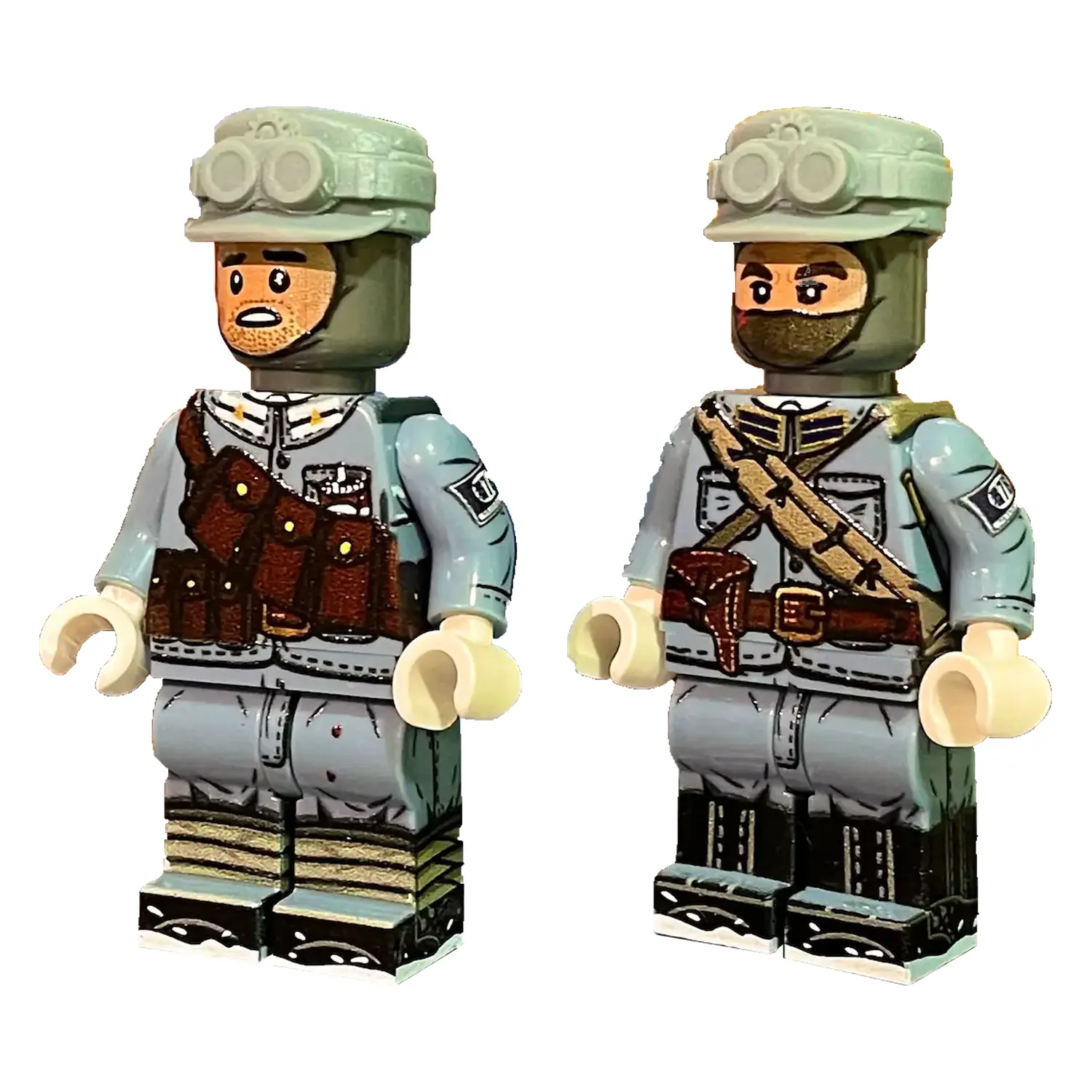
This two-figure custom printed brick block collection brings together the Japanese Motorcyclist and Japanese Artillery Cadet themes of the World War II period. Matching blue-gray uniforms and goggle headpieces give the pair a consistent appearance, while their face, equipment and lower-leg prints distinguish the individual figures.
1. Japanese Motorcyclist
Character Identification
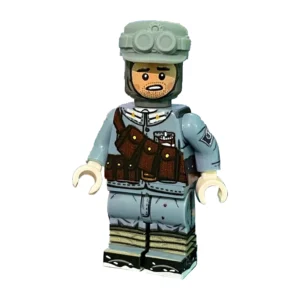
The motorcyclist is the figure with an open-mouth expression, printed stubble, prominent brown chest pouches and khaki-colored wrap-style lower-leg printing.
Detailed Character Description
- Headgear & Face: A pale gray-green goggle headpiece has dark side coverings; the face print features dark brows, highlighted eyes, an open mouth and stubble.
- Torso & Uniform: The blue-gray tunic has light collar panels, small yellow collar accents, a central fastening line and a dark sleeve-patch print.
- Equipment Printing: A brown diagonal strap and multiple prominent brown pouch prints cross the front, with small yellow fastener details and a brown belt.
- Legs & Footwear: Blue-gray trousers carry seam and crease details above khaki-colored wrap-style printing and dark footwear.
- Hands & Accessories: Pale hands are pictured empty; the figure wears the goggle headpiece shown in the photographs.
Historical / Thematic Background
Motorcycles formed part of Japanese military transport during World War II. They belonged to a broader movement system that also relied on trucks, bicycles, horses and hand- or animal-drawn carts. Motor transport added another means of moving personnel and equipment, while the usable routes and the needs of each unit determined how these different forms of transport could be employed.
Japanese military motorcycles included designs adapted from Harley-Davidson machines. A 1944 United States War Department handbook described several Japanese models and identified the Model 97 as a type believed to be in general use. Sidecar arrangements were also documented, showing that these machines served a military purpose beyond ordinary civilian travel.
The collection's motorcyclist interprets this transport theme through a goggle headpiece, printed brown equipment pouches and wrap-style lower-leg details. Pairing the rider with the artillery cadet gives builders two distinct roles for wartime camp, training and transport scenes. The motorcycle history provides context for the figure's role; the photographs show the character itself with empty hands.
2. Japanese Artillery Cadet
Character Identification
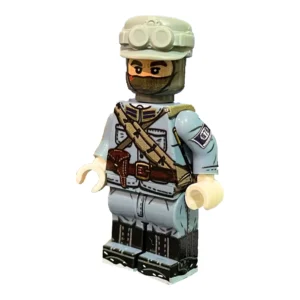
The artillery cadet is the figure with a dark lower-face covering, crossed tan strap printing, brown belt and holster-shaped details, and tall dark lower-leg printing.
Detailed Character Description
- Headgear & Face: A pale gray-green helmet-style headpiece has a short brim, two raised round goggles and dark side coverings. The face print shows dark eyebrows, highlighted eyes and a dark covering over the lower face.
- Torso & Uniform: The blue-gray tunic has two outlined chest pockets, a central fastening line, dark collar panels edged in gold and contrasting shoulder details. A dark geometric sleeve patch with small light markings is visible.
- Equipment Printing: Tan straps cross the torso and include dark fastening details. Brown belt and holster-shaped printing, with a contrasting buckle, surrounds the waist; these details are printed on the figure.
- Legs & Footwear: Matching blue-gray trousers carry seam and crease details, with tall dark lower-leg printing and dark footwear.
- Hands & Accessories: The figure has pale hands and is pictured with empty hands, wearing the goggle headpiece shown in the product photographs.
Historical / Thematic Background
The artillery-cadet theme recalls the specialist training behind wartime gun crews. During World War II, Japan's army maintained separate paths for regular officers, reserve officer candidates and technically trained soldiers. Artillery instruction was provided through branch schools and practical service with units, reflecting the skills needed to turn recruits into members of a coordinated gun team.
Artillery work extended beyond operating a cannon. Japanese field-artillery organizations included observation and signal personnel, alongside the gun crews and ammunition units. Observers watched the ground and the fall of shells, while communication links connected their information to the firing positions. Range finders, telescopes and aiming instruments helped crews translate observations into the direction and elevation of a gun.
Field and mountain artillery supported infantry operations, with some units using horses or pack animals and others employing motor transport. Moving guns, ammunition and equipment was therefore part of the same larger system as training and fire control. The cadet role offers a way to explore these supporting duties in a historical brick scene.
This figure presents that subject through its blue-gray uniform, crossed strap printing and distinctive goggle headpiece. It is a stylized wartime character for training, transport or artillery-themed displays.
Collection Historical / Thematic Background
This collection pairs two complementary wartime themes: military transport and artillery training. During World War II, Japan's army combined infantry and specialist arms with the transport, communication and supply services needed to support them. The two characters offer a compact way to introduce those supporting roles in a brick display.
The motorcyclist theme reflects the use of motorcycles within Japan's wider transport system. The artillery-cadet theme draws attention to the preparation required for gun crews and the personnel who worked alongside them. Artillery organizations included observation, signal and ammunition elements, so their effectiveness depended on more than the gun and its crew alone.
Transport and artillery were also connected in practical terms. Guns, ammunition and optical or communication equipment had to reach their positions, whether moved by motor vehicles, horses or pack animals. Training prepared personnel to work within these organized teams and to use the instruments and procedures on which artillery fire relied.
In the photographs, the figures share goggle headpieces and blue-gray uniforms but have visibly different equipment and leg printing. The motorcyclist's brown chest pouches and light lower-leg wraps contrast with the cadet's crossed tan straps, holster-shaped waist detail and dark lower legs, giving each member a clear place in the paired display.
Reviews
There are no reviews yet