

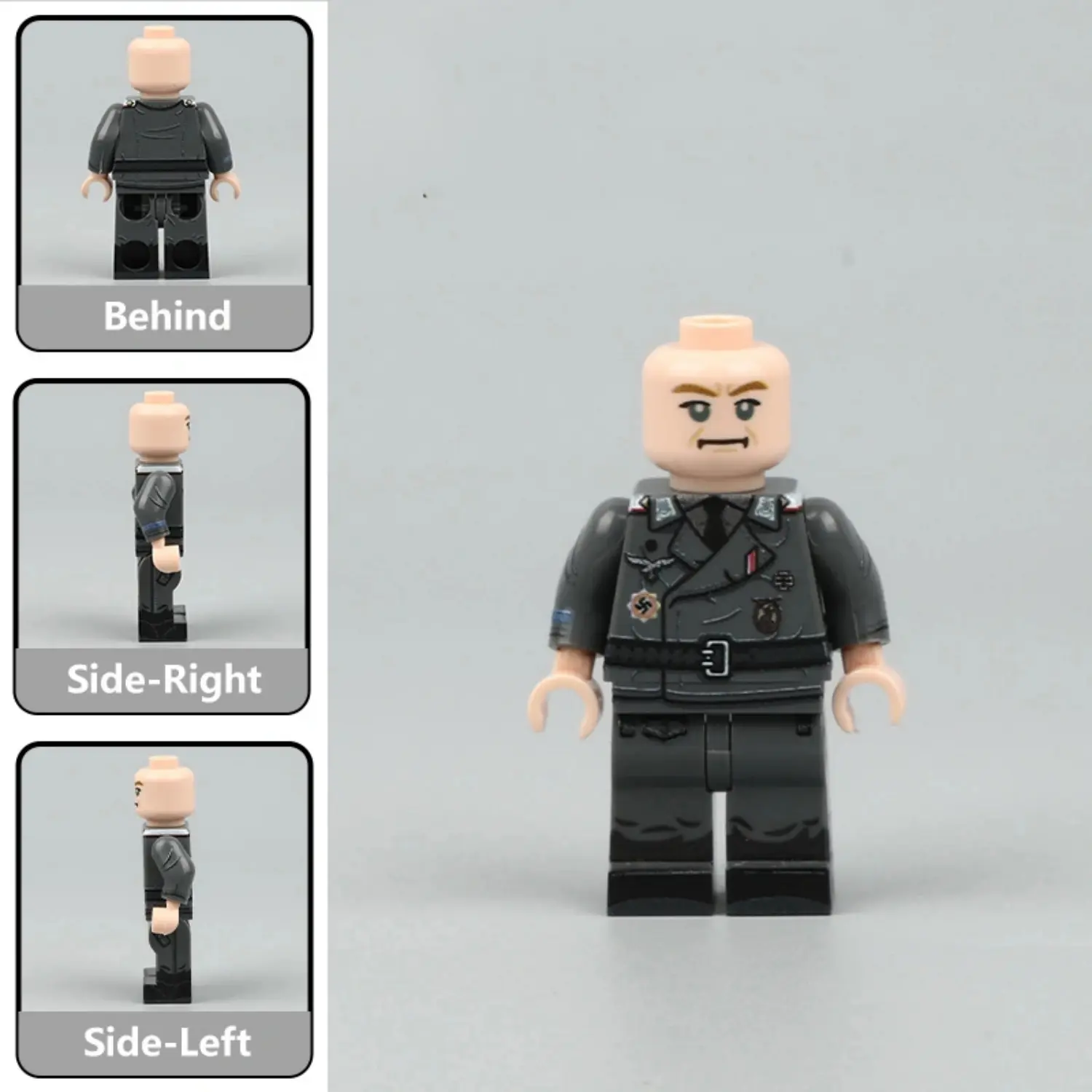
this showcases a single, highly detailed custom UV-printed building block figure.
It is important to note that this figure does not represent the historical leader Hermann Göring himself, but rather an elite, highly decorated tank commander serving within the prestigious armored division that bore his name.
Here is the detailed English description, specific character identification, and historical background for this distinguished armored commander.
Character Identification: The Decorated Luftwaffe Tank Commander
-
Specific Name: WW2 German Panzer Commander / Highly Decorated Officer (Fallschirm-Panzer-Division 1. Hermann Göring)
-
Role: A senior armored vehicle commander or officer belonging to the Luftwaffe’s premier ground combat division during World War II, distinguished by a very high level of combat awards.
Detailed Visual Breakdown
-
Facial Features: Unlike the battle-dirty or cigar-smoking variants, this figure features a clean-shaven, focused, and confident expression. This pristine look often denotes an officer or a commander posing for a formal portrait or operating in a higher command capacity.
-
Upper Body Uniform (The Panzerjacke):
-
He is dressed in the standard German Panzer wrap jacket (Panzerjacke) in dark grey/black. The double-breasted, short-waisted design was explicitly tailored to prevent snagging on the interior machinery of a tank.
-
Visible beneath the open lapel is a formal black shirt and black tie, adhering strictly to Panzer troop dress regulations.
-
Insignia: His collar features black tabs with white piping, displaying the traditional silver Panzer death’s head (Totenkopf). A Luftwaffe flying eagle is prominently printed on his right breast, denoting his branch of service (Air Force rather than Army).
-
Extensive Combat Medals: This specific variant is heavily decorated for prolonged bravery:
-
Iron Cross 2nd Class: The red, white, and black ribbon is printed diagonally through his lapel buttonhole.
-
German Cross in Gold (Deutsches Kreuz in Gold): The most striking feature of this figure is the large, star-burst medal printed on his right abdomen. This was a highly prestigious award given for exceptional and repeated acts of bravery or military leadership.
-
Left Breast Awards: On his left chest, he wears the Iron Cross 1st Class (a pin-back cross) alongside the Panzer Assault Badge (Panzerkampfabzeichen), awarded for participating in multiple armored assaults.
-
-
The Cuff Title (Right Sleeve): The “Side-Right” profile distinctly shows a blue cuff band with silver borders on his lower right arm. This is the exclusive “Hermann Göring” cuff title, instantly confirming his membership in this elite unit.
-
-
Lower Body & Back Profiles:
-
He wears a standard black leather waist belt with a silver officer’s buckle.
-
The lower body features matching dark grey Panzer trousers, designed to tuck neatly into black marching boots.
-
The “Behind” view shows the clean, unencumbered back of the wrap jacket, essential for moving quickly through tank hatches.
-
Historical Background: The Elite “Fire Brigade”
This figure beautifully captures the unique aesthetic and prestige of one of Germany’s most heavily decorated combat divisions during the Second World War.
-
The Luftwaffe’s Panzer Force: Tank warfare was historically the domain of the German Army (Heer). However, the Fallschirm-Panzer-Division 1. Hermann Göring was a major exception. Evolving from a small police detachment into a fully equipped Panzer division, it remained under the direct command of the Luftwaffe (German Air Force). It served as Hermann Göring’s personal elite ground force and was used as a “fire brigade” to plug collapsing front lines in North Africa, Italy, and the Eastern Front.
-
Hybrid Uniforms: Because they were Air Force personnel operating tanks, their uniforms were a unique hybrid. They utilized the highly functional Panzer wrap jackets developed by the Army, but retained Luftwaffe breast eagles and collar tab piping. Furthermore, they wore their prestigious cuff title on the right sleeve, whereas Army units traditionally wore them on the left, creating a distinct visual identity.
-
The German Cross in Gold: The inclusion of the Deutsches Kreuz in Gold on this figure’s abdomen is highly significant. Instituted in 1941, it ranked between the Iron Cross 1st Class and the Knight’s Cross. A tank commander wearing this award was a battle-hardened veteran who had demonstrated extraordinary and repeated combat excellence over a long period, making this figure a representation of the division’s top-tier leadership.
Reviews
There are no reviews yet