

Character Identification
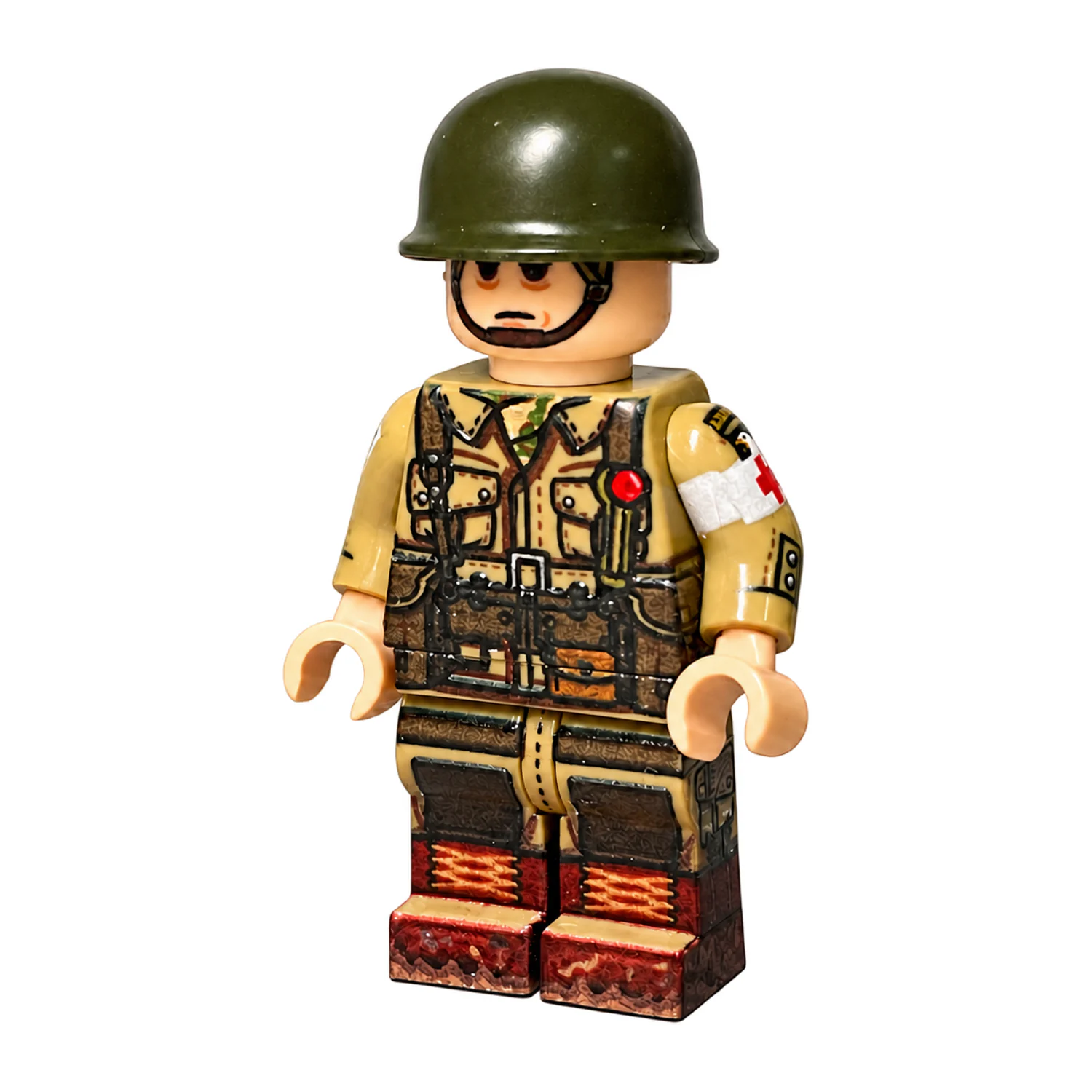
This custom building block figure represents a brave Combat Medic attached to the US 101st Airborne Division (“Screaming Eagles”) during World War II. He is immediately distinguishable by his non-combatant medical insignias, specifically the prominent white Red Cross armband on his left sleeve, specialized medic webbing, and the iconic M1942 paratrooper uniform.
Detailed Character Description
(Utilizing pristine 360-degree UV printing, this figure meticulously captures the specialized loadout, non-combatant identifiers, and mud-soaked gear of an American airborne medic operating in the European theater.)
-
Headgear & Face: The figure is crowned with a standard olive-drab M1 steel helmet. To secure the helmet during the violent jolt of a parachute jump, the printed leather chin cup strap is visibly fastened across his chin. The face print conveys a solemn, battle-weary expression with dark circles under the eyes and subtle dirt smudging, reflecting the grueling physical and emotional toll of frontline medical duty.
-
Torso (M1942 Uniform & Medical Insignia): He is dressed in the classic tan M1942 Paratrooper Jump Jacket, tailored with four snap-buttoned cargo pockets. A printed camouflage parachute silk scarf is tucked into the open collar to prevent neck chafing. On his left shoulder rests the famous 101st Airborne Division patch. Directly below this patch is his most vital piece of identification: a large, highly visible white brassard (armband) bearing a bold Red Cross. Additionally, a small red circular emblem is printed on his left chest pocket, further designating his medical role.
-
Web Gear & Equipment: Unlike riflemen or NCOs, this medic’s printed chest and waist webbing is devoid of standard ammunition bandoliers. Instead, he wears specialized medic suspenders and a customized pistol belt equipped with specific cantle ring pouches and medical kits. These pouches were designed to hold life-saving field supplies such as morphine syrettes, sulfa wound powder, bandages, tourniquets, and surgical scissors.
-
Legs & Footwear: His lower half is outfitted in matching M1942 paratrooper trousers, featuring the large, billowing cargo pockets often stuffed to the brim with extra medical supplies. The knees are reinforced with dark canvas patches to prevent the fabric from tearing when kneeling beside wounded soldiers in rough terrain or rubble. The legs terminate in highly detailed brown leather Corcoran jump boots, heavily caked in printed, realistic mud around the soles, heels, and lower laces, illustrating the harsh, wet conditions of the Normandy and Holland drop zones.
Historical Background
During the airborne assaults of World War II, such as the D-Day drops into Normandy on June 6, 1944, and Operation Market Garden, Combat Medics of the 101st Airborne Division jumped directly into the darkness and chaos alongside the infantry. Often unarmed or carrying only a sidearm to defend their patients, these medics relied heavily on their Red Cross armbands and helmet markings to identify themselves as non-combatants under the Geneva Conventions—though in the heat of battle, this offered little real protection from artillery or crossfire. Airborne medics were required to carry all their medical supplies on their person during the drop, utilizing their specialized webbing and the oversized pockets of their M1942 uniforms to haul plasma and bandages. Their bravery was legendary; they routinely sprinted into open enemy fire to drag wounded paratroopers to safety, administer immediate field care, and establish makeshift aid stations behind enemy lines without reliable supply chains.
Reviews
There are no reviews yet