

Character Identification
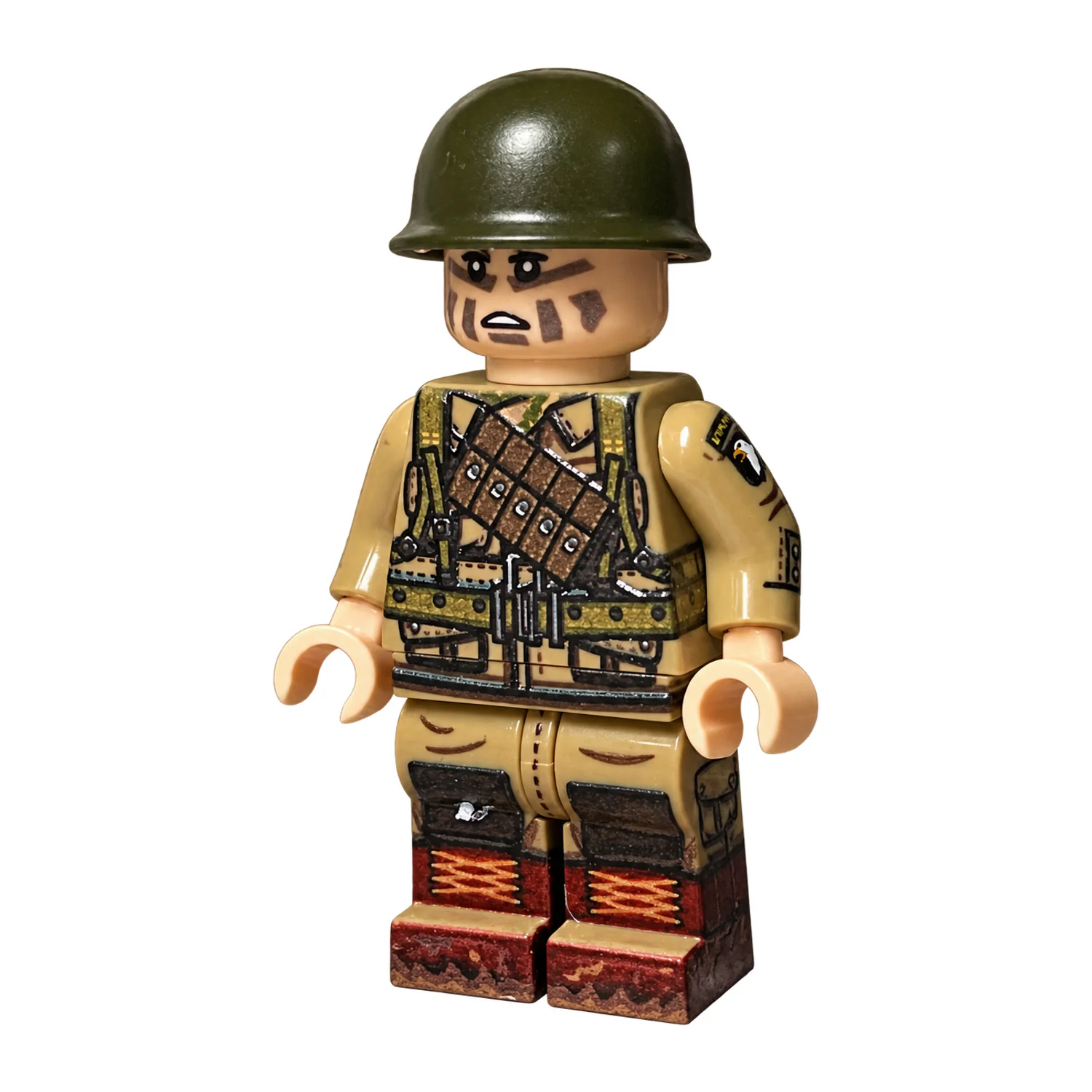
This custom building block figure represents a Radio Operator of the elite US 101st Airborne Division (“Screaming Eagles”) deployed during World War II, easily recognizable by his dark tactical facial camouflage, heavy angled ammunition bandolier, and the iconic 101st divisional patch.
Detailed Character Description
(Utilizing precise 360-degree UV printing, this figure meticulously captures the overburdened and specialized field gear of an American airborne radio operator dropped into the Normandy hedgerows, tasked with maintaining vital communications while heavily armed for self-defense.)
-
Headgear & Face: The figure is crowned with a standard olive-drab M1 steel helmet. Beneath the rim, his face is heavily printed with thick, aggressive stripes of dark black tactical camouflage (a technique frequently utilized by paratroopers using burnt cork, soot, or weapon grease to eliminate skin glare during night operations). His expression is tense and alert, featuring a slightly open mouth as if shouting coordinates or orders over the din of battle.
-
Torso (M1942 Uniform & Web Gear): He is outfitted in the iconic, reinforced tan M1942 Paratrooper Jump Jacket, tailored with large, snap-buttoned cargo pockets. A printed camouflage parachute silk scarf is visible tucked into the collar, a common field modification used to protect the neck from the abrasive canvas straps of heavy gear. The left shoulder proudly displays the 101st Airborne Division patch. His chest webbing is uniquely detailed for a soldier carrying heavy communication equipment: he wears a standard M1923 cartridge belt loaded with ammunition around his waist, overlaid with a prominent, six-pocket cotton bandolier slung diagonally across his chest for rapid reloading of his primary weapon. His intricate suspender harness is printed over the jacket, designed to help distribute the massive weight of a backpack radio unit.
-
Legs & Footwear: His lower half features matching M1942 paratrooper trousers, distinguished by their large, billowing side cargo pockets designed to hold extra batteries, radio components, and rations. The knees are heavily reinforced with dark canvas patches, an essential modification added by riggers to prevent fabric blowouts when taking a knee in the abrasive terrain to transmit a message. The legs terminate in highly detailed brown leather Corcoran jump boots, complete with intricate lacing and heavily covered in printed, realistic mud around the soles and lower heels, perfectly illustrating the wet, muddy conditions of the French countryside.
Historical Background
During the chaotic night drops of Operation Overlord (D-Day) on June 6, 1944, the paratroopers of the 101st Airborne Division jumped behind enemy lines into the darkness of Normandy. In the scattered confusion of the drop, Radio Operators were among the most critical and highly targeted soldiers on the battlefield. Carrying the heavy and cumbersome SCR-300 backpack radio (the original “walkie-talkie”), they provided the only lifeline for squad leaders to coordinate scattered troops, call in naval artillery fire, and establish command outposts. Because the radio antenna made them obvious targets for German snipers, operators had to heavily camouflage their faces with burnt cork and arm themselves to the teeth with extra bandoliers, ensuring they could fiercely defend their vital communication equipment in the isolated early hours of the invasion.
Reviews
There are no reviews yet