

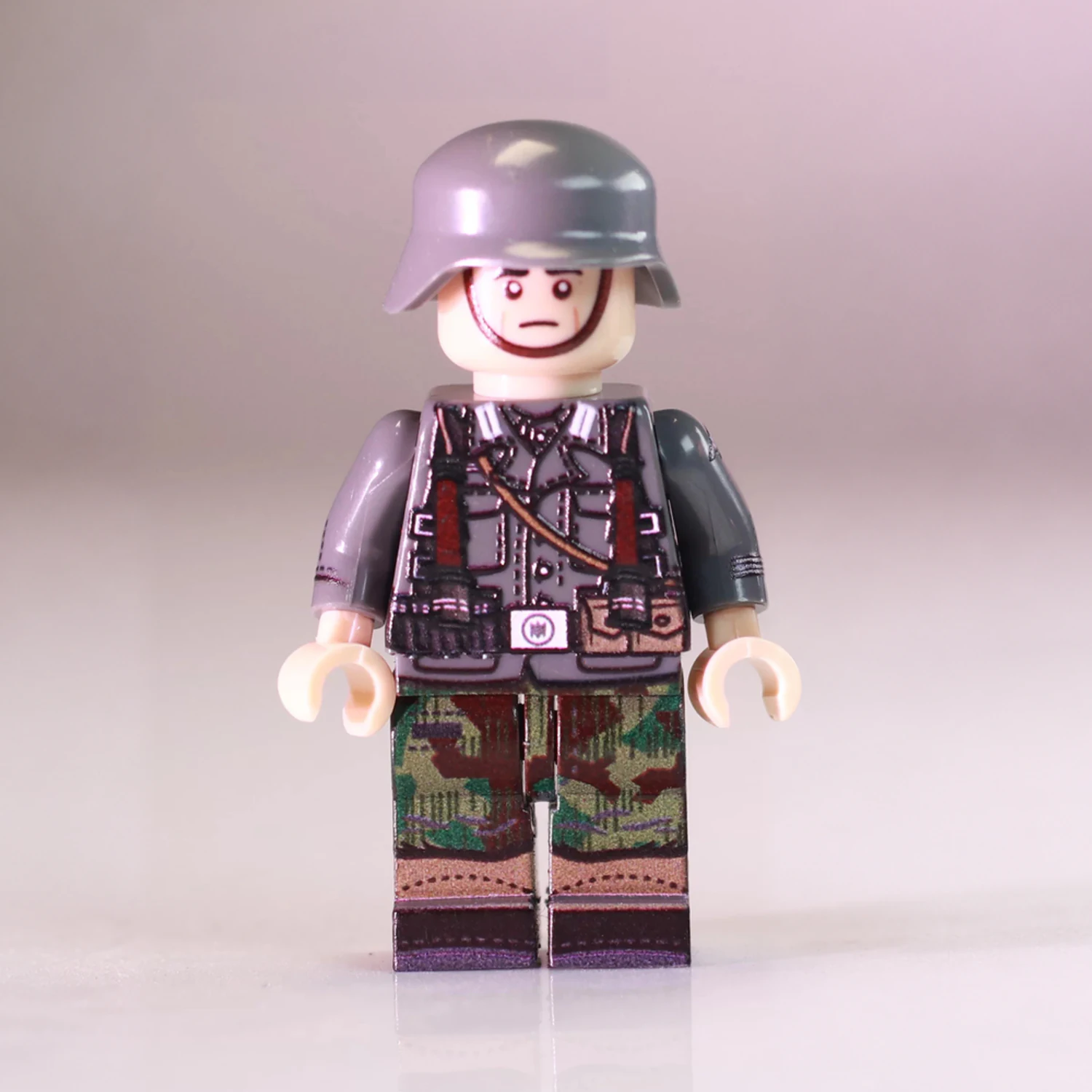
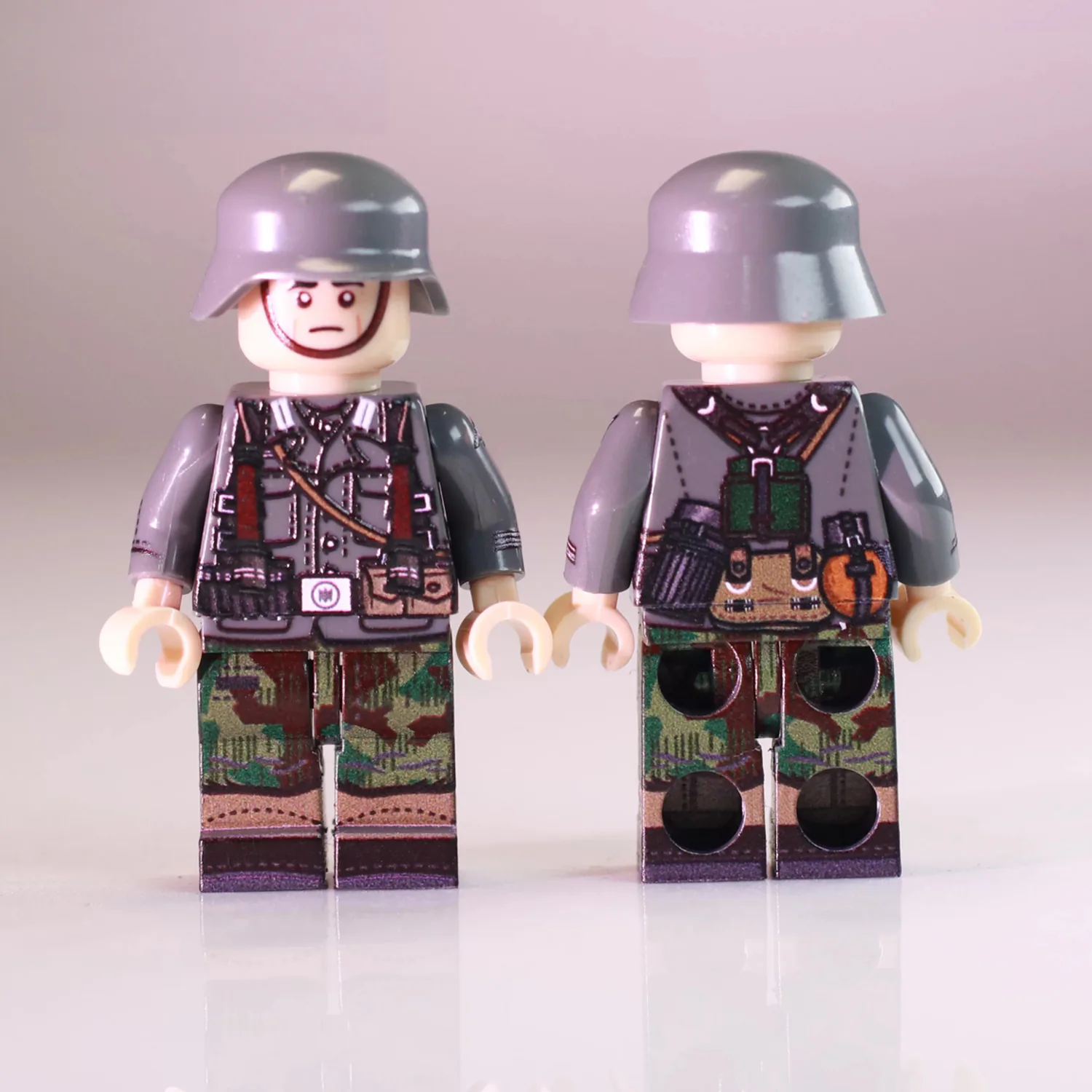
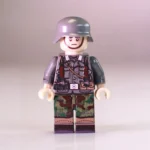
Character Identification This custom building block figure represents a German Wehrmacht Infantryman operating during the late stages of World War II, highly representative of forces fighting in the Normandy campaign. The figure is clearly identifiable by his classic Stahlhelm, standard Feldgrau tunic, and combat trousers printed in a distinctive, late-war green-dominant Splittertarnmuster (Splinter) camouflage pattern variant.
Detailed Character Description
(Utilizing precise 360-degree UV printing, this figure meticulously captures the mixed-uniform reality and heavy field gear of a frontline German soldier in 1944.)
-
Headgear & Face: The figure is crowned with a standard issue, dark grey Stahlhelm (steel helmet). The face print displays a stoic, resolute expression, detailed with a brown printed chinstrap securing the helmet.
-
Torso & Field Gear (Front): The torso features the classic German Feldgrau (field grey) combat tunic, complete with historically accurate silver-braid collar tabs. Over the tunic, the figure wears standard black leather Y-strap suspenders. A black waist belt, fastened with a silver Wehrmacht belt buckle, supports a heavy combat loadout: triple-cell rifle ammunition pouches are clearly printed on the right side, while a utility pouch rests on the left. A brown leather cross-strap is also visible across the chest.
-
Back View & Equipment: The highly detailed reverse side showcases the continuation of the Y-strap suspenders supporting a massive amount of essential survival gear. Attached to the rear belt and back webbing is a green canvas A-frame assault pack, a brown canvas bread bag, a ribbed cylindrical gas mask canister, and a standard issue field canteen with a brown cover.
-
Legs (Camouflage): Contrasting with the formal grey tunic, the lower half features highly detailed combat trousers printed in a vibrant, green-heavy variant of the Splittertarnmuster (Splinter) camouflage. This pattern accurately depicts the sharp geometric splotches of brown and dark green over a light green base, overlaid with distinct vertical “rain dashes”. The trousers transition into printed canvas gaiters and standard low marching boots.
Historical Background
By the time of the Allied invasion of Normandy in June 1944, the German military was facing severe supply and manufacturing shortages. As a result, frontline infantrymen rarely received complete, matching uniform sets. It became incredibly common for soldiers to mix whatever gear was available, resulting in the iconic late-war aesthetic captured by this figure: combining standard wool Feldgrau tunics with specialized camouflage trousers. The Splittertarnmuster camouflage pattern featured on the trousers was originally introduced in the 1930s for tent quarters (Zeltbahnen) but was widely tailored into field clothing late in the war to provide vital concealment in the dense hedgerows and mixed woodlands of the European theater. The heavy loadout of a gas mask canister, A-frame, canteen, and bread bag accurately reflects the burden carried by infantrymen during extended defensive campaigns.
Reviews
There are no reviews yet