

Variations
Introduction
English Title & Specific Name
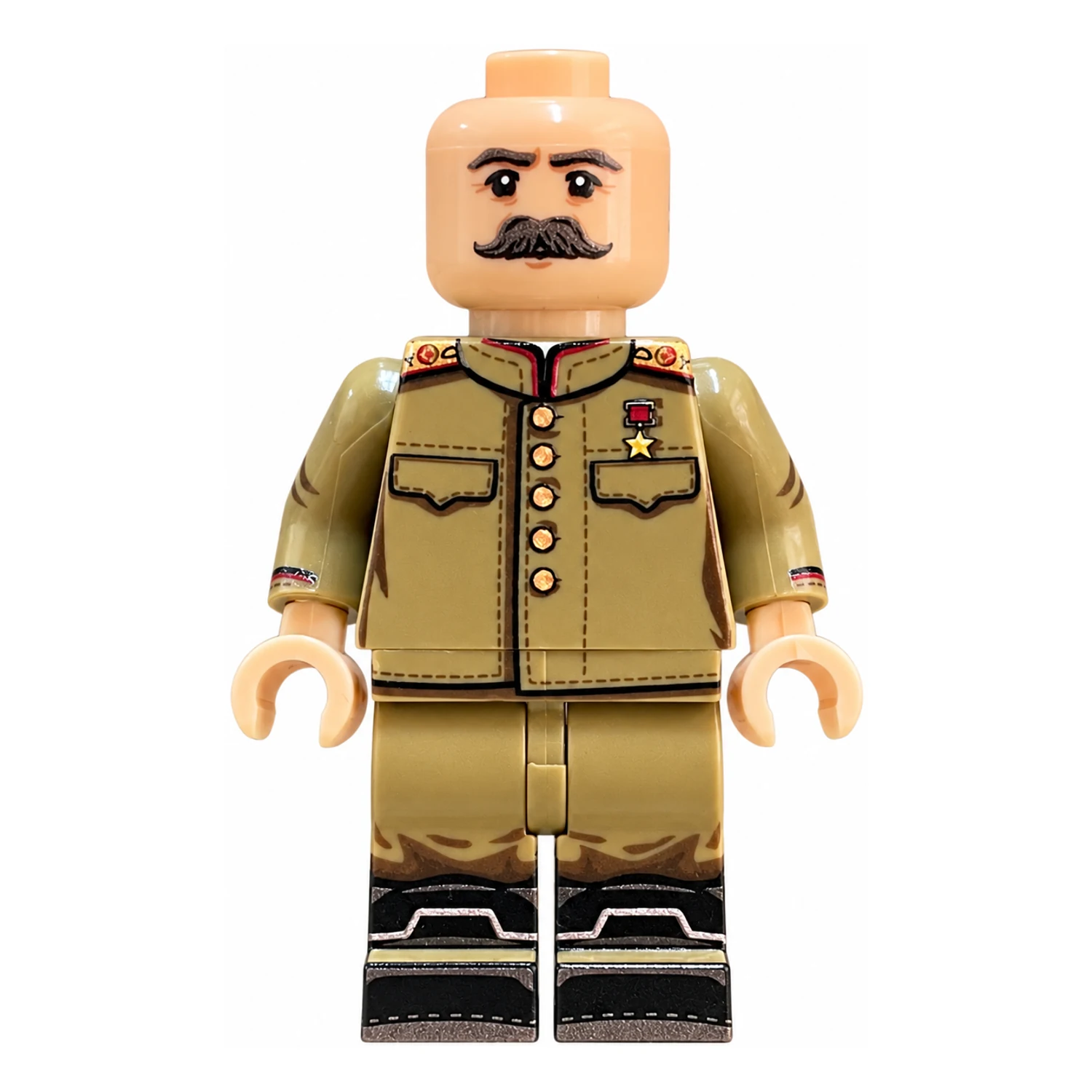
- Figure Title: Joseph Stalin Khaki Military Uniform Soviet Era – Custom Printed Brick Block Figure
- Historical Era: Soviet era; mid-twentieth-century military-style presentation
- Faction / Military Branch: Soviet Union political leadership
Detailed Character Identification, Description, and Historical Background
Character Identification
A brick figure depicting Joseph Stalin in a khaki Soviet-era military-style uniform. The moustache artwork, decorated shoulder boards and star-shaped chest detail establish the model’s visual presentation as a Soviet political leader.
Detailed Character Description
The bare head has dark eyebrows and a broad dark moustache with gray highlights and raised tips. The khaki stand-collar jacket is outlined with dark seams and red collar edging, with five gold-colored buttons and two breast-pocket flaps. Gold-colored shoulder-board artwork includes small red circular details. A red rectangular tab and a gold-colored five-pointed star appear above one pocket. The arms continue the khaki color with dark fold marks and red/dark cuff edging. Matching trousers have brown fold shading above black footwear artwork with pale metallic-colored bands. The hands are empty, and no headgear or handheld accessory is shown in the supplied views.
Included contents: One complete figure with the pictured khaki uniform and moustache face artwork.
Historical / Thematic Background
Joseph Stalin became the dominant political leader of the Soviet Union by the end of the 1920s and remained in power until his death in March 1953. His authority extended across the Communist Party and the Soviet state. During the Second World War he directed the Soviet war effort, making his public image closely associated with both political leadership and military command.
Stalin’s government pursued rapid industrialization and forced collectivization of agriculture, concentrating economic decisions in the state. These policies were accompanied by famine and enormous human loss. Political repression expanded through arrests, executions, forced labor and deportations, with the Great Terror of the 1930s targeting the party, armed forces and wider population. This record is central to understanding the period represented by the figure.
In July 1945, Stalin joined Harry S. Truman and Winston Churchill at Potsdam to discuss the settlement after Germany’s defeat. That wartime and early postwar setting provides context for the figure’s khaki tunic, shoulder decoration and star-shaped chest detail. Its strong moustache, dark eyebrows, buttoned jacket and black footwear form a compact interpretation of Stalin’s military-style public appearance, suited to a historically contextualized twentieth-century display.
Reviews
There are no reviews yet