
English Title & Specific Name
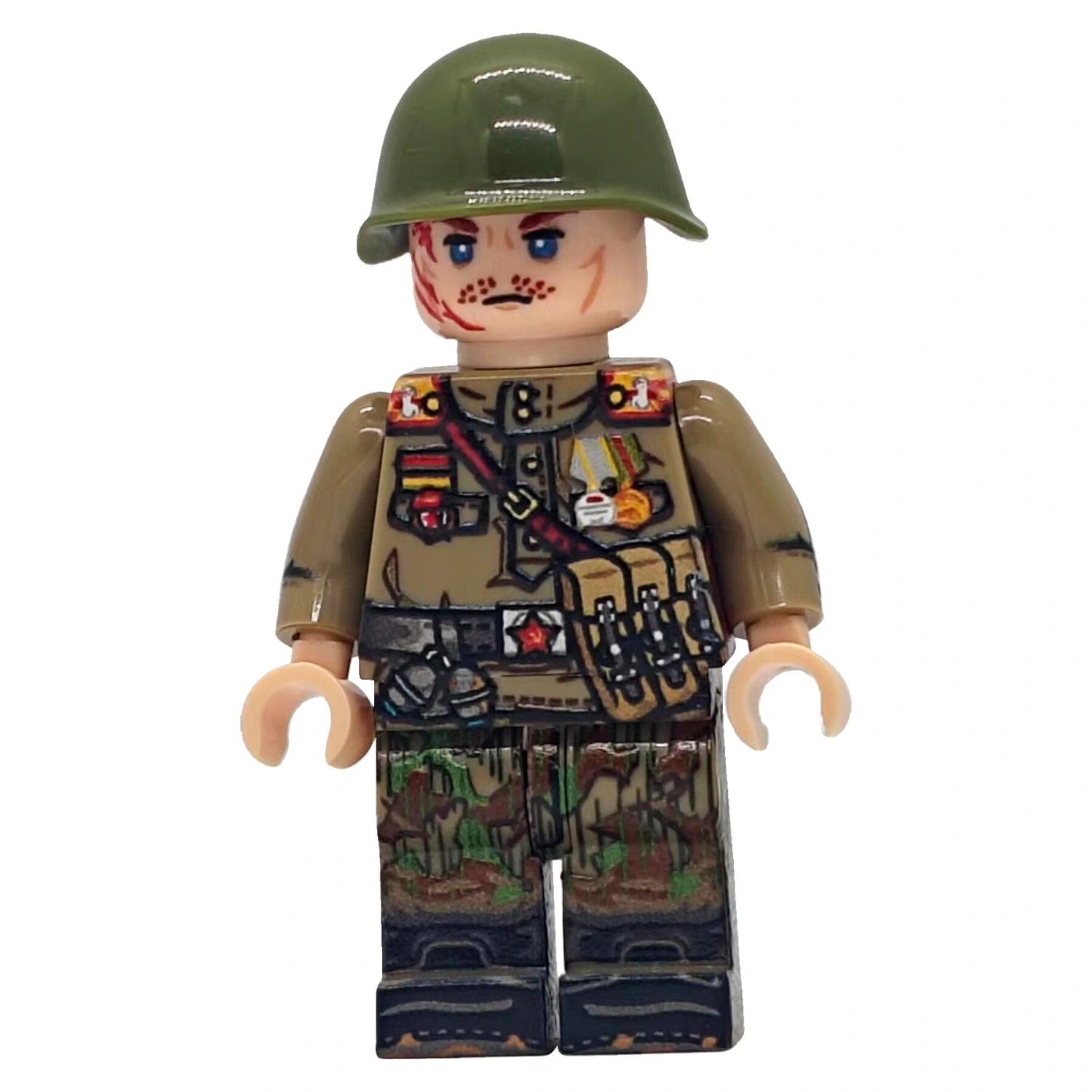
Figure Title: Soviet Officer in Khaki Tunic and Splinter Camouflage Trousers
Historical Era: World War II.
Faction / Military Branch: Soviet Red Army officer theme.
Detailed Character Identification, Description, and Historical Background
Character Identification
An unnamed Soviet officer character combining a green steel-helmet shape, khaki tunic, medal artwork and distinctive camouflage trousers. The printed face and detailed field equipment give the figure a battle-worn appearance.
Detailed Character Description
The olive green helmet sits above blue eyes, dark eyebrows, a small moustache and reddish facial scratch marks. The khaki tunic has a standing collar, coloured shoulder insignia, medal and ribbon printing, and an angled reddish-brown strap. Tan chest pouches, dark grenade illustrations and a black belt with a red-star buckle are printed on the torso. Green, brown and tan angular camouflage covers the trousers, above dark boots with worn-looking highlights. The medals, strap, pouches, grenades and belt are printed artwork on the figure.
Included Contents
One complete printed brick figure with the pictured olive green helmet.
Historical / Thematic Background
The Red Army was the Soviet Union’s land force during World War II. Germany’s invasion of the Soviet Union on 22 June 1941 opened the German-Soviet theatre of the conflict, a vast front that extended across cities, villages, forests and agricultural regions. Soviet forces fought through defensive battles and later offensives that carried the fighting westward into Central Europe. A Soviet officer figure can help represent the command role within a display about this wartime setting.
Steel helmets formed part of the Red Army’s field equipment. The Soviet SSh-40 entered service in 1940 and used a rounded shell with a projecting front brim and improved internal padding. This figure’s green helmet follows that familiar wartime silhouette, while its khaki tunic and red-star belt artwork reinforce the Soviet military theme. The rank and individual awards are left at the level of the visible printed design.
The angular camouflage trousers and facial marks distinguish this character from a plain-uniform officer. Its mixture of decoration and field-equipment artwork suits a command post, an advancing infantry group or a battle-worn diorama. The character remains an unnamed historical-theme design, allowing it to complement a broader Soviet collection without assigning a personal biography, precise unit or particular battle to the figure.
Reviews
There are no reviews yet