







Variations
-
Ancient Greek Spartan Style Hoplite with Lambda Shield – Custom Printed Brick Block Figure
$9.99 -
Ancient Greek Hoplite with Three Legs Shield – Custom Printed Brick Block Figure
$9.99 -
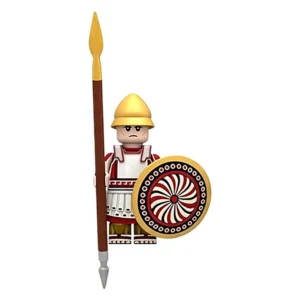
Ancient Greek Hoplite with Spiral Shield – Custom Printed Brick Block Figure
$9.99 -
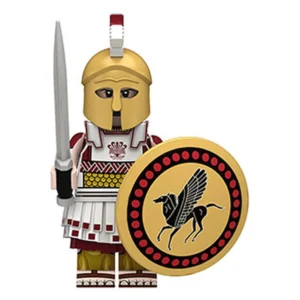
Ancient Greek Hoplite with Pegasus Shield – Custom Printed Brick Block Figure
$9.99 -
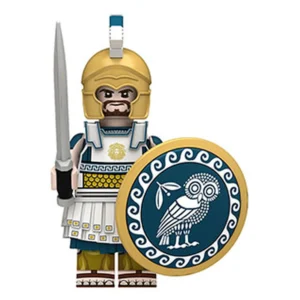
Ancient Greek Hoplite with Owl Shield – Custom Printed Brick Block Figure
$9.99 -
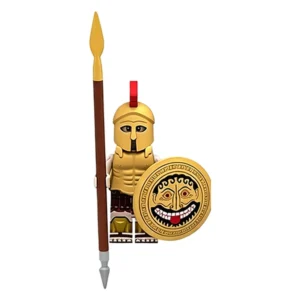
Ancient Greek Hoplite with Gorgon Shield – Custom Printed Brick Block Figure
$9.99 -
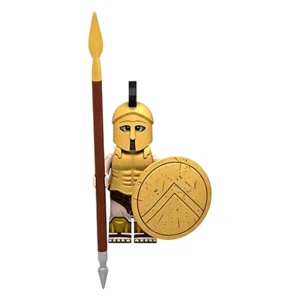
Ancient Greek Hoplite with Engraved Gold Shield – Custom Printed Brick Block Figure
$9.99 -
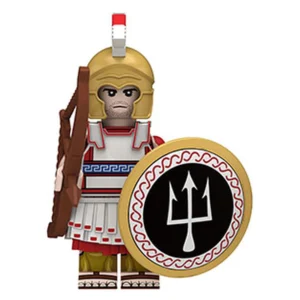
Ancient Greek Archer with Trident Shield – Custom Printed Brick Block Figure
$9.99
Introduction
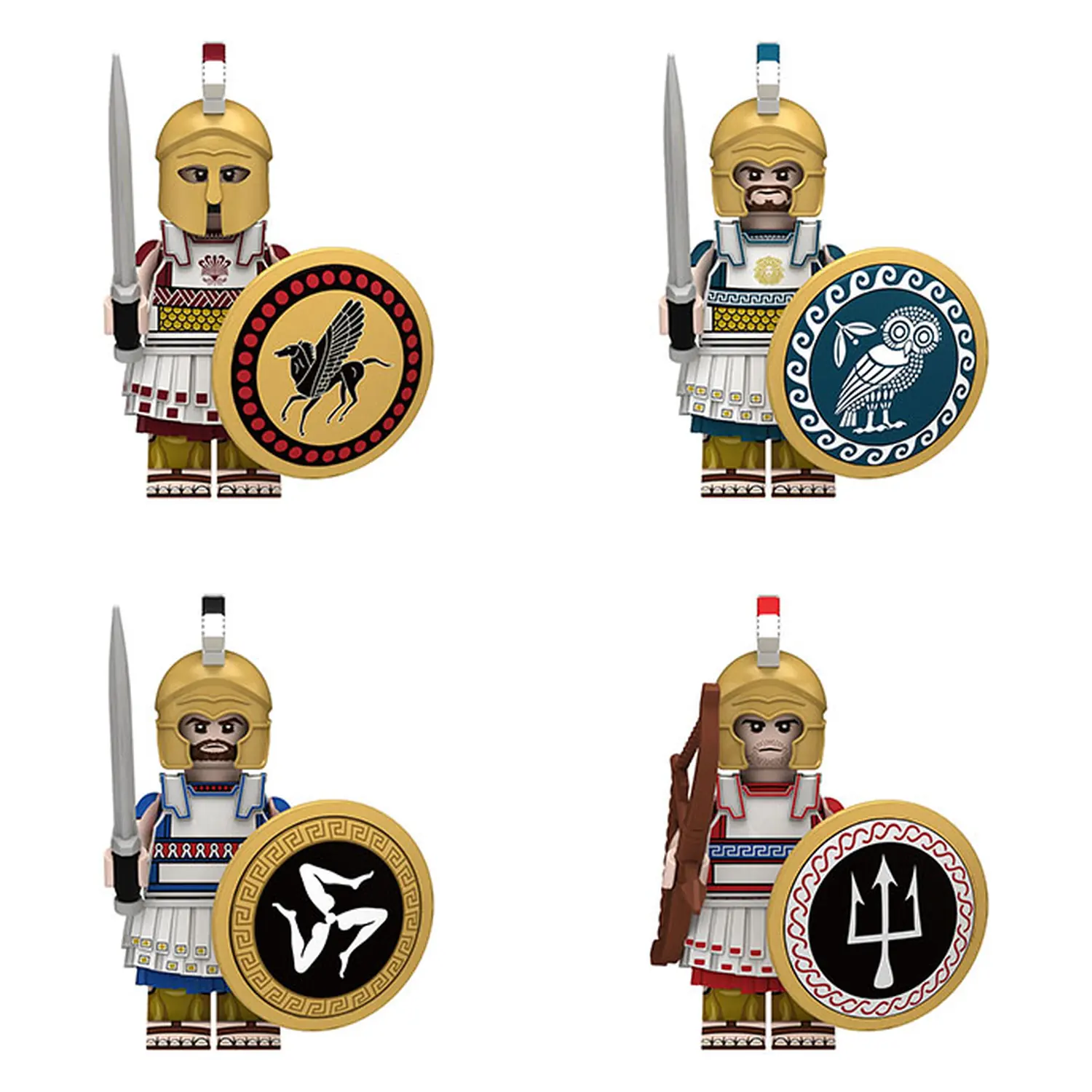
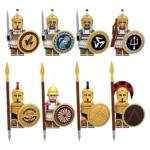
This eight-figure collection combines seven Greek-inspired infantry warriors and one bow-carrying archer. Each design appears once: Pegasus, owl, three-legs, trident, Gorgon, spiral, weathered gold chevron and red lambda shields. Alternate group images show the same included members.
1. Ancient Greek Hoplite with Pegasus Shield
Character Identification
A generic ancient Greek-inspired infantry warrior distinguished by its pegasus shield design. This unnamed design has no assigned rank or personal biography.
Detailed Character Description
gold closed-face helmet with a narrow red-and-white crest; red, white and gold printed armor, patterned waist, white skirt details with dark red accents and gold greave-style leg printing. Included equipment: a silver-colored straight sword with black grip; gold-rimmed round shield with a black winged horse and red dotted border; removable white/red armor and skirt components.
Historical / Thematic Background
Pegasus is the winged horse of Greek myth. Corinth used the creature on its ancient coinage, where it served as an immediately recognizable civic image. That connection offers useful context for this shield design, but a winged-horse emblem alone cannot establish the home city or military unit of an individual warrior. The figure is best understood as a modern Greek-inspired hoplite design.
The large shield creates the strongest visual contrast with the narrow sword and tall helmet crest. Its circular arrangement places the winged horse at the center, while the red dotted border echoes the red accents in the clothing. This makes the figure useful as a distinctive character within an imagined Greek shield line, without assigning it a named historical commander.
Greek helmet terminology often describes a form rather than the wearer’s home city. Museum examples of Corinthian-type helmets are discussed as equipment used in Greek heavy-infantry warfare more broadly. The face-covering helmet on this design contributes to that visual theme, while its painted crest and Pegasus shield remain features of this particular modern interpretation.
2. Ancient Greek Hoplite with Owl Shield
Character Identification
A generic ancient Greek-inspired infantry warrior distinguished by its owl shield design. This unnamed design has no assigned rank or personal biography.
Detailed Character Description
gold open-face helmet with a teal-and-white crest and a printed bearded face; teal, white and gold armor decoration, a gold central face-like emblem, patterned waist, layered white skirt details and gold greave-style leg printing. Included equipment: a silver-colored straight sword with black grip; gold-rimmed teal shield with white owl, olive-spray-like detail and white wave border; removable white/teal armor and skirt components.
Historical / Thematic Background
The owl is strongly associated with Athena and ancient Athens, notably through Athenian silver coinage. The wide round eyes, small branch and compact bird on this toy shield recall that familiar visual language. The association is thematic: it does not document a particular Athenian regiment, a real warrior or an exact shield recovered by archaeology.
Teal provides this figure with a clear identity among the red, blue and gold designs in the collection. The owl graphic rewards close viewing, while the shield remains readable at the smaller scale of a brick display. Its bearded face and contrasting helmet crest allow the builder to give it an individual role in a fictional gathering of ancient Greek warriors.
Ancient civic imagery could move between different objects and media. The Athena-and-owl pairing on Athenian coinage provides a documented example of the bird’s importance, while the toy translates that association into a shield decoration. That is a useful way to discuss its theme without treating the illustrated shield as a proven regulation pattern.
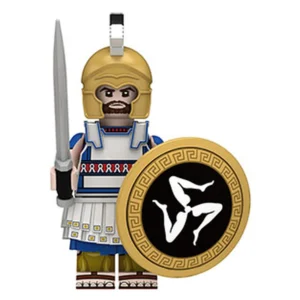
3. Ancient Greek Hoplite with Three Legs Shield
Character Identification
A generic ancient Greek-inspired infantry warrior distinguished by its three legs shield design. This unnamed design has no assigned rank or personal biography.
Detailed Character Description
gold open-face helmet with a black-and-white crest and a printed bearded face; blue-and-white armor design with red waist accents, white skirt details and gold greave-style leg printing. Included equipment: a silver-colored straight sword with black grip; gold-rimmed black shield bearing three bent white legs and a geometric key border; removable white/blue armor and skirt components.
Historical / Thematic Background
The three bent legs form a triskeles-like design, a motif discussed in studies of ancient Greek imagery and coinage. Its striking rotational symmetry makes it well suited to the circular surface of a shield. The pattern should not be treated as an exclusively Athenian badge or evidence that this figure belonged to a named force. Here it functions as an individual visual emblem within a Greek-inspired toy collection.
The white limbs stand out against black, while the surrounding gold key pattern links the shield to the figure’s gold helmet and leg decoration. Blue trim distinguishes its clothing from the neighboring owl and Pegasus designs. It can anchor an imagined guard or shield-line scene, with its identity established by the visible motif rather than an invented biography.
The triskeles also appears in ancient coin imagery beyond Athens: a coin of the Lycian ruler Perikle places it beside a Greek-style helmeted warrior. This wider context explains why the three-legged emblem should be treated cautiously as an identity clue. The figure’s visible blue trim and shield pattern remain its reliable distinguishing features.
4. Ancient Greek Archer with Trident Shield
Character Identification
A generic ancient Greek-inspired archer distinguished by its trident shield design. This unnamed design has no assigned rank or personal biography.
Detailed Character Description
gold open-face helmet with red-and-white crest and a printed stubbled face; white armor outlined in red, a blue geometric waist band, white skirt components with red details and gold greave-style leg printing. Included equipment: a brown molded bow-and-arrow accessory; gold-rimmed black shield with white trident and red wave border; removable white/red armor and skirt components. The trident is a shield graphic; the bow-and-arrow is one molded accessory.
Historical / Thematic Background
The bow makes this figure an archer-themed warrior rather than another spear-carrying hoplite. Its shield carries a trident, an emblem associated with Poseidon in Greek visual culture. That symbolic reference does not make the character a depiction of the god, prove naval service, or indicate that a physical trident comes with the toy. The weapon actually shown is the brown bow-and-arrow accessory.
This combination gives the eight-figure collection a useful change of role and silhouette. The curved bow contrasts with the long spears of the other group, and the red-edged white clothing makes the archer easy to find in a display. Treat the equipment arrangement as an imaginative Greek-themed design, not a claim that every historical Greek archer carried this exact heavy shield and armor combination.
Archery appears in ancient Greek sculpture as a distinct activity, with the archer drawing a string and arrow rather than fighting with a thrusting spear. The Acropolis Museum preserves an archer torso with that recognizable action. This figure expresses the bow-bearing role in a simplified standing pose, while retaining its own decorative shield and armor.
5. Ancient Greek Hoplite with Gorgon Shield
Character Identification
A generic ancient Greek-inspired infantry warrior distinguished by its gorgon shield design. This unnamed design has no assigned rank or personal biography.
Detailed Character Description
gold closed-face helmet with a narrow red crest; gold muscle-cuirass-style printing and separate gold armor, brown/red skirt decoration, gold greave-style legs and sandal-style foot printing. Included equipment: a long brown spear with gold-colored point and gray butt spike; a curved silver-colored sword with gold grip; gold-rimmed shield with a grinning Gorgon-style face; removable gold breastplate.
Historical / Thematic Background
The shield’s staring eyes, broad teeth and protruding tongue evoke the Gorgon imagery of ancient Greek art. A bronze Gorgon head in the Acropolis Museum is interpreted as a possible shield emblem or vessel ornament, showing how such faces could appear on objects as well as in myth. This toy uses that visual tradition as a bold decorative focus; it does not reproduce that specific museum object.
The gold muscle-shaped armor and long spear place the figure within a recognizable Greek warrior vocabulary. The patterned face on the shield adds a mythic element without turning the soldier into Medusa or another named character. Red and brown clothing accents distinguish it from the lambda and chevron variants, making it suitable for an imaginative group in which each shield has a different emblem.
Gorgon faces combine mythology with the visual language of protection. Ancient Greek artists represented Medusa in a range of forms, from frightening features to more human appearances. This shield selects the emphatic, staring version of that tradition, making the face an identifying decorative motif rather than evidence of a named wearer or a single city-state.
6. Ancient Greek Hoplite with Spiral Shield
Character Identification
A generic ancient Greek-inspired hoplite distinguished by its spear, round spiral shield and protective clothing. This unnamed design has no assigned rank or personal biography.
Detailed Character Description
plain gold conical cap-style helmet and a printed stern, clean-shaven face; white-and-red armor decoration, diagonal brown strap printed on the body, white skirt components and gold greave-style leg printing. Included equipment: a long brown spear with gold-colored point and gray butt spike; gold-rimmed red, white and black spiral shield; removable white/red armor and skirt components. The supplied weapon is the spear.
Historical / Thematic Background
The spear and round shield give this figure a Greek infantry theme, while the simpler cap-style helmet creates a different outline from the crested helmets in the group. The red, white and black spiral is a visible decorative pattern; the supplied evidence does not tie it to a named city, unit or dated military standard. It should be presented as a design choice rather than a documented heraldic identification.
The circular pattern suggests motion even when the figure is standing still, contrasting with the upright spear and straight-edged armor decoration. White armor and red trim connect it to the archer and Pegasus designs, but its face, helmet and shield remain distinct. The figure can be used in an imagined camp, guard post or infantry scene without claiming participation in a particular historical campaign.
A spear, shield and protective clothing are central elements in museum explanations of Greek infantry equipment. This design retains that basic combination but changes the helmet silhouette and shield decoration. Its simpler headgear and strong spiral help demonstrate the variety possible within a modern collection inspired by Greek soldiers, without suggesting a uniform historical issue.
7. Ancient Greek Hoplite with Engraved Gold Shield
Character Identification
A generic ancient Greek-inspired hoplite distinguished by its gold-colored shield with engraved-look chevron decoration. This unnamed design has no assigned rank or personal biography.
Detailed Character Description
gold closed-face helmet with a narrow black crest; bare-chest-style printing beneath separate gold muscle armor, brown lower clothing, printed wrist details and gold greave-style leg printing. Included equipment: a long brown spear with gold-colored point and gray butt spike; curved silver-colored sword with gold grip; gold-colored shield with double-chevron line and distressed-looking marks; removable gold breastplate.
Historical / Thematic Background
This figure centers on the combination of a long spear, circular shield and muscle-shaped armor. Those features evoke the equipment vocabulary of ancient Greek heavy infantry, while the toy’s shield uses a restrained geometric emblem instead of a bird or mythological face. The Engraved Gold Shield name describes engraved-look lines and distressed decoration on a gold-colored toy shield; it does not indicate an actual engraving process, metal construction or historical battle damage.
Printed body detail sits underneath the separate breastplate, creating layered clothing and armor. Its narrow black helmet crest and gold shield create a quieter palette than the vivid red or teal variants. It suits an imagined veteran or guard role, but no actual rank, service record or identity is assigned to this generic character.
The term panoply describes a collection of offensive and defensive equipment rather than one isolated item. Museum presentations of Greek helmets and greaves place them alongside the spear, shield and sword. The supplied spear, shield, breastplate and alternate blade give this figure a similar equipment-based theme, while their shapes and decoration remain stylized toy components.
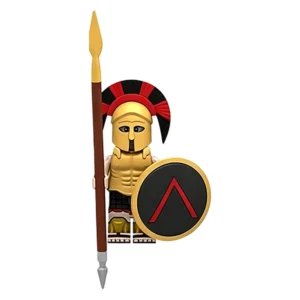
8. Ancient Greek Spartan Style Hoplite with Lambda Shield
Character Identification
A generic Spartan-style hoplite distinguished by its red lambda shield design and crested helmet. This unnamed design has no assigned rank or personal biography.
Detailed Character Description
gold closed-face helmet with a broad red-and-black crest; gold muscle-cuirass-style print beneath separate gold armor, black skirt decoration with red edging, gold greave-style legs and sandal-style foot printing. Included equipment: a long brown spear with gold-colored point and gray butt spike; curved silver-colored sword with gold grip; gold-rimmed black shield with a red lambda-shaped emblem; removable gold breastplate.
Historical / Thematic Background
The bold red lambda-shaped mark and broad helmet crest give this warrior a familiar Spartan-style appearance in modern Greek-themed displays. Those features create a generic Greek warrior rather than a named historical soldier or a reconstruction of equipment from a specific battle. The figure is an ancient Greek-inspired, Spartan-style hoplite, with the emblem described directly rather than used to invent a personal identity.
Its black shield field, red border accents and gold armor produce strong contrast beside the lighter spiral and Pegasus variants. A spear supplies the tall vertical line, while the separate curved sword offers an alternate accessory. These choices support imaginative shield-wall and camp scenes. They should not be treated as evidence that all ancient Greek communities used identical equipment or that this toy is an archaeological replica.
Close-order Greek infantry depended on shields as well as individual weapons: museum accounts describe formations advancing with overlapping shields. The prominent circular shield and upright spear make that collective role a useful background for this figure. The broad crest and red emblem provide individuality, but do not prove that it served in a particular historical formation.
Overall Historical / Thematic Background
This collection explores different modern interpretations of ancient Greek warriors. Round shields, protective headgear and body armor create a shared infantry theme, while the bow-bearing figure introduces a different role. Mythological emblems and geometric patterns distinguish the members; together they form an imaginative collection rather than a documented single historical unit.
The set may be used to develop an ancient camp, an assembly or a shield-line scene. Each of the eight supplied designs appears once, with its shown equipment. The variety of printed clothing, headgear and shields offers a way to compare design choices without assigning invented ranks, biographies or battlefield participation.
Reviews
There are no reviews yet