

Variations
Introduction
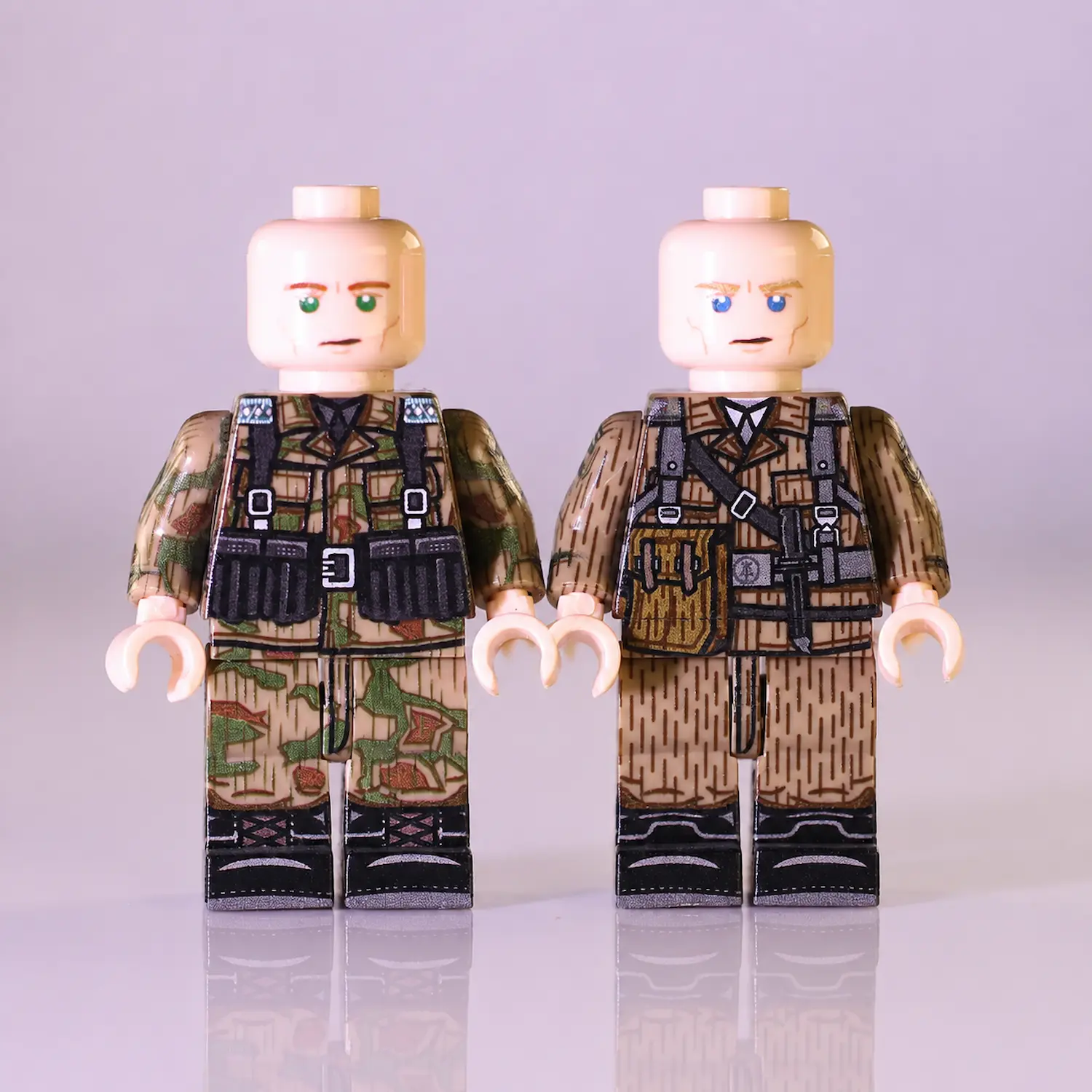
This Cold War dual set represents opposing forces stationed along the Inner German Border during the height of East-West tensions, featuring authentic uniforms from both West Germany’s Federal Border Guard and East Germany’s National People’s Army.
1. Left Figure: Cold War West German Border Guard (BGS) Trooper
-
English Name: Cold War West German Border Guard (BGS) Trooper in Sumpfmuster (Marsh Camo)
-
Faction / Unit: West German Federal Border Guard (Bundesgrenzschutz – BGS)
-
Historical Era: Cold War (1950s–1970s)
Character Identification & Detailed Description This custom building block figure represents a West German Federal Border Guard Trooper assigned to high-stakes patrol duty along the Iron Curtain.
-
Head & Face: Features a light nougat head print with striking green eyes, light brown eyebrows, and a sharp, focused expression.
-
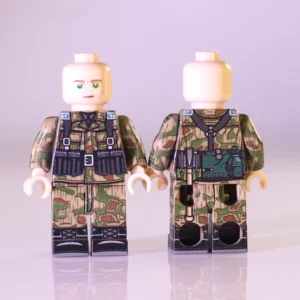
Torso & Uniform: Dressed in the classic West German BGS Sumpfmuster (Marsh/Swamp pattern) jacket, featuring soft tan, green, and reddish-brown blurred camouflage shapes. Printed green rank tabs adorn his shoulder straps.
-
Tactical Gear: Black leather Y-strap suspenders hold a heavy combat belt equipped with rigid black leather G3 magazine pouches, historically designed to store 20-round magazines for the HK G3 battle rifle.
-
Legs & Footwear: The leg blocks continue the detailed Sumpfmuster camouflage trousers and terminate in tall black lace-up combat boots, complete with printed lace and sole details.
Historical Background Established in 1951, the Bundesgrenzschutz (BGS) was West Germany’s federal paramilitary force created to protect borders and maintain internal security. Positioned directly opposite East German and Soviet forces, the BGS stood on the front line of the Cold War. Unlike the West German Army (Bundeswehr), which adopted olive drab uniforms, the BGS uniquely retained a modified version of the Sumpfmuster camouflage pattern from the 1950s through the late 1970s. Armed with the HK G3 rifle, BGS troopers conducted daily patrols along watchtowers, fences, and riverways.
2. Right Figure: Cold War East German NVA Infantryman
-
English Name: Cold War East German NVA Infantryman in Raindrop Camouflage (Strichtarn)
-
Faction / Unit: East German National People’s Army (Nationale Volksarmee – NVA)
-
Historical Era: Cold War (1960s–1980s)
Character Identification & Detailed Description This custom building block figure represents an East German Motor-Rifle Soldier serving in the Warsaw Pact’s frontline defense along the East-West German border.
-
Head & Face: Features a light nougat head print with striking blue eyes, blonde eyebrows, and a calm, disciplined face print.
-
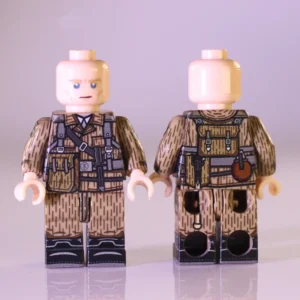
Torso & Uniform: Outfitted in the iconic Strichtarn (Raindrop / Line camouflage) field jacket, known informally as “Ein Strich – kein Strich” (“one line – no line”), displaying thin vertical brown lines printed over a khaki-grey background.
-
Tactical Gear: Grey Y-strap suspenders support a belt with a printed East German NVA military belt buckle (featuring the national hammer, compass, and wreath emblem). Attached to his right hip is a specialized curved AK-47 canvas magazine pouch.
-
Legs & Footwear: The legs continue the Strichtarn camouflage trousers and end in polished black combat boots with detailed sole stitching.
Historical Background Formed in 1956, the Nationale Volksarmee (NVA) was the standing military force of East Germany. Positioned at the core of Western/Eastern bloc friction, NVA motorized infantry were among the most strictly trained forces within the Warsaw Pact. In 1965, East Germany standardized Strichtarn camouflage, designed to blend into Central European terrain and break up silhouettes under early infrared night-vision technology. Equipped with licence-built Kalashnikov rifles (MPi-K series), NVA troops maintained constant readiness along the Berlin Wall and border checkpoints until Germany reunited in 1990.
Reviews
There are no reviews yet