

English Name & Identification
-
Subject Name: WWII German Flakhelfer / Volkssturm Conscript
-
English Translation: WWII German Anti-Aircraft Auxiliary (Flakhelfer) Minifigure (Late-War Edition)
-
Historical Era: World War II (1939–1945)
Character Identification, Description, and History
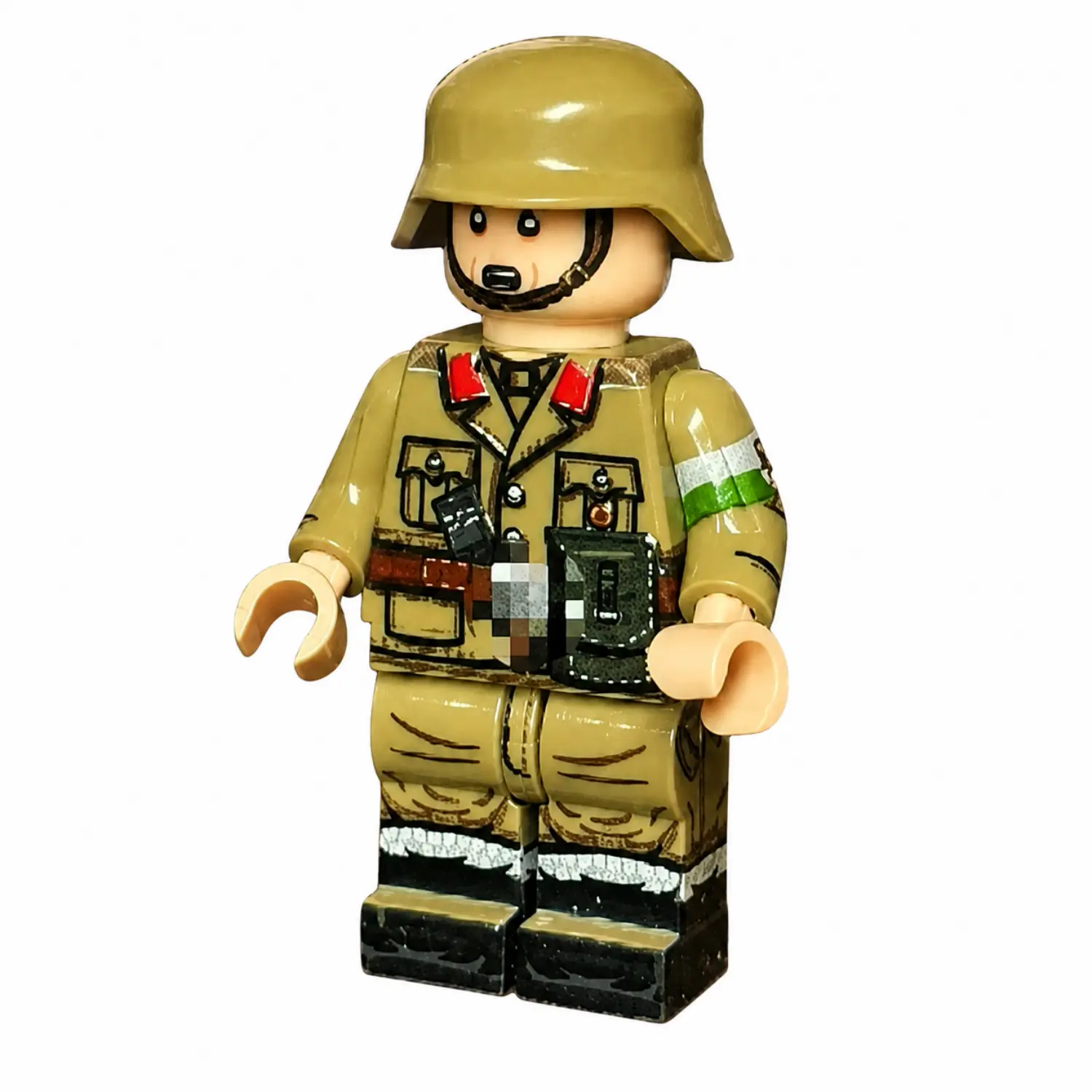
Character Identification This custom figure represents a World War II German youth conscript, specifically operating as a Flakhelfer (anti-aircraft auxiliary) or a late-war Volkssturm (Home Guard) member. The tan uniform combined with military headgear reflects the desperate mobilization of non-combatants during the war’s final months.
Detailed Character Description (This custom figure utilizes 360-degree UV printing to capture the makeshift, piecemeal uniforms of late-war German defense forces.)
-
Headgear & Face: The figure is topped with a dark tan or Dunkelgelb Stahlhelm (steel combat helmet). The face print portrays a distressed, open-mouthed expression of a young, battle-weary conscript, complete with a printed leather chin strap resting on the jaw.
-
Torso (Uniform & Insignia): He wears a tan tunic adorned with striking red collar tabs, which historically denoted the Flak (anti-aircraft) artillery branch. A white and green identification armband wraps around his left sleeve. His chest features a brown combat belt, a green utility or map pouch, a small black tactical accessory (such as a whistle or radio microphone) on the right pocket, and a pixelated central insignia (intentionally blurred for international toy safety compliance).
-
Legs & Footwear: The lower half features matching tan field trousers. The ankles show printed heavy white winter socks or fabric gaiters wrapped just above standard black marching boots, completing the mismatched, late-war aesthetic.
Historical Background As the strategic bombing of German cities intensified and frontline manpower collapsed, the regime conscripted hundreds of thousands of teenage boys from the Hitlerjugend (Hitler Youth) to serve as Flakhelfer (Luftwaffe auxiliaries). These youths manned heavy anti-aircraft batteries, freeing up adult soldiers for the Eastern and Western fronts. The red collar tabs specifically indicated their attachment to the Flak artillery units.
By early 1945, as Allied ground forces pushed directly into Germany, these same poorly equipped youths were absorbed into the Volkssturm and ordered to fight heavily armed infantry and tanks in brutal urban combat. They rarely received proper field grey uniforms, fighting instead in their tan youth or auxiliary tunics paired with surplus military helmets.
Reviews
There are no reviews yet