

English Title & Specific Name
-
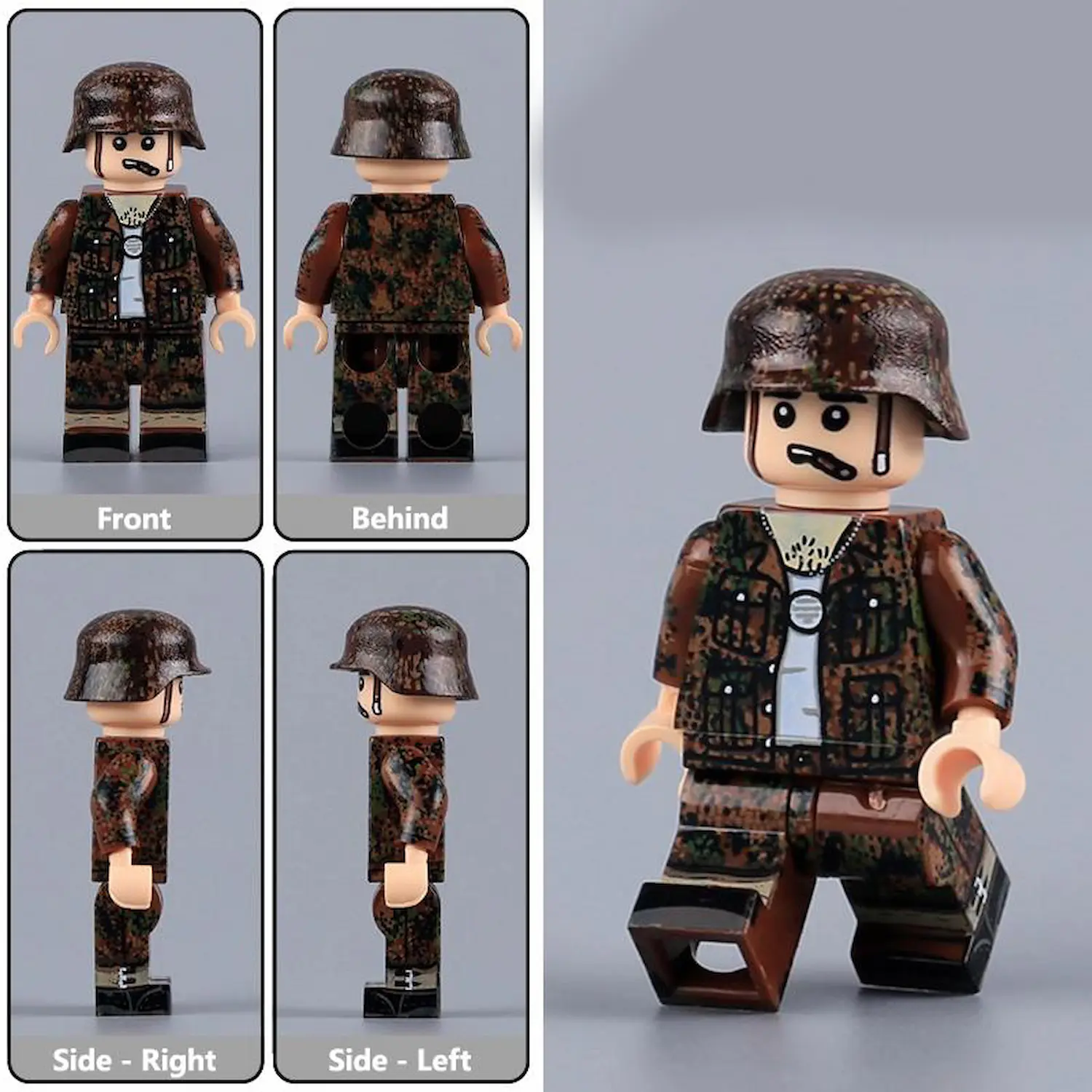
Figure Title: WWII German Waffen-SS Soldier (Dot 44 / Erbsenmuster Camouflage)
-
Historical Era: World War II (1939–1945)
-
Faction / Military Branch: German Waffen-SS
Detailed Character Identification, Description, and Historical Background
Character Identification This custom building block figure represents a frontline soldier of the Waffen-SS during the final year of World War II. He is depicted in a candid, off-guard moment, characterized by his partially unbuttoned uniform and the act of hastily putting on his boot. The figure is defined by his late-war Dot 44 (Erbsenmuster) camouflage, a universal combat uniform issued specifically to SS units starting in early 1944 to replace earlier pull-over smocks.
Detailed Character Description (Utilizing 360-degree UV printing, this figure captures a highly detailed, narrative-driven moment of a soldier interrupted during a brief rest.)
-
Headgear & Face: The figure wears a standard M40/M42 Stahlhelm (steel helmet), covered in a cloth helmet cover printed with the matching Dot 44 camouflage pattern. His face print tells a story of frontline exhaustion: he features heavy stubble, wide eyes indicating surprise or urgency, and a printed cigar clamped in his mouth.
-
Torso (Dot 44 Uniform & Identification): His torso features the M44 combat tunic, printed meticulously with the five-color Erbsenmuster (pea dot) camouflage, which consists of a brownish background layered with distinct spots of light green, dark green, pinkish-tan, and black. The tunic is worn open, exposing a plain white undershirt. Hanging prominently over the undershirt is an oval metal disc on a cord—this is the Erkennungsmarke (identification tag), complete with a printed horizontal line across its center.
-
Legs & Footwear: His lower half features trousers in the matching Dot 44 pattern. To emphasize the candid nature of the figure, the right leg is printed with standard camouflage and a black combat boot, while the left leg is designed to look like the soldier is mid-action. He holds a detached black marching boot in his hand, while the foot attached to the leg reveals a grey sock, simulating an interrupted rest period.
Historical Background By 1944, the German war machine was severely strained by material shortages. To streamline uniform production, the Waffen-SS introduced the M44 Erbsenmuster uniform. Unlike earlier camouflage that was printed on loose smocks meant to be worn over standard wool uniforms, the Dot 44 pattern was printed directly onto a lightweight, two-piece drill uniform (tunic and trousers) meant to be worn on its own in warmer weather or over winter gear. It was designed to provide effective concealment in all seasons without needing to be reversible.
The oval disc hanging around this soldier’s neck is a historically critical piece of equipment. The Erkennungsmarke (dog tag) was issued to every German soldier. Unlike the rectangular tags used by the American military, the German tag was a single oval aluminum or zinc disc scored with three slits down the middle. Both halves were stamped with the soldier’s blood type, roster number, and unit replacement depot. If a soldier was killed in action, the tag was snapped in half along the scored line; the lower half was collected for casualty records, while the upper half remained attached to the body for future identification.
Reviews
There are no reviews yet