

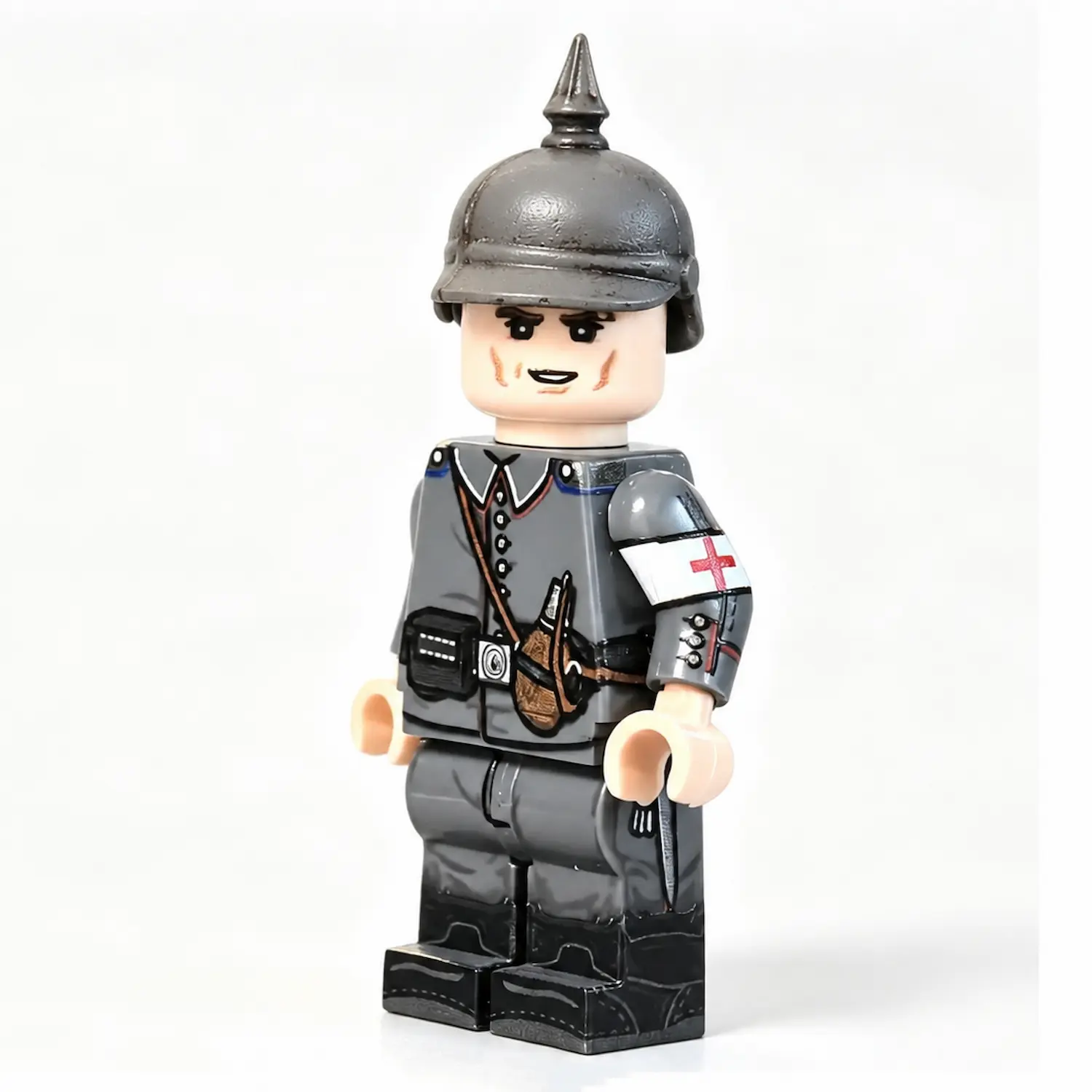
this showcases a single, highly detailed custom building block figure.
This character represents a brave combat medic of the Imperial German Army during the early stages of World War I (circa 1914–1915), before the grim realities of trench warfare forced major uniform changes.
Here is the detailed English description, specific character identification, and historical background for this early-war medical soldier.
Character Identification: The Early-War Healer
-
Specific Name: WWI Imperial German Army Combat Medic (Sanitäter) – Early War Variant
-
Role: A specialized, non-combatant infantryman tasked with braving the battlefield to treat wounded soldiers, stabilize casualties, and organize their evacuation to rear-line field hospitals.
Detailed Visual Breakdown
-
Headgear (The Pickelhaube): The most defining feature of this figure is the grey spiked helmet (Pickelhaube). Standard issue at the outbreak of the war in 1914, this helmet is depicted in grey to represent either a later oxidized steel version or the canvas field cover (Überzug) used to hide the shiny leather and brass from enemy snipers.
-
Facial Features: He has a confident, slightly smiling expression with printed dirt and wear on his cheeks, reflecting the grueling and chaotic nature of frontline medical work.
-
Upper Body Uniform (The Feldgrau Tunic):
-
He wears the standard Field Grey (Feldgrau) tunic, which replaced the brightly colored uniforms of the 19th century to provide better camouflage. It features traditional red piping down the front closure and on the cuffs, along with blue piping on the shoulder boards.
-
The Medic’s Mark: Prominently printed on his left arm is a white armband featuring a Red Cross. This internationally recognized symbol was intended to mark him as a non-combatant under the Geneva Convention.
-
Medical Gear: Across his chest is a printed diagonal leather strap holding a brown medical satchel (first aid pouch), which would historically contain bandages, tourniquets, iodine, and morphine. He also wears a black waist belt with a small black leather equipment pouch.
-
-
Lower Body:
-
He wears matching field grey trousers.
-
His footwear consists of tall black leather marching boots (Marschstiefel), commonly known as jackboots. These were standard for German infantry early in the war before supply shortages and deep trench mud made ankle boots and puttees (cloth leg wraps) more practical.
-
Historical Background: The Sanitäter in 1914
This figure is a perfect historical snapshot of the German military aesthetic at the dawn of the First World War.
-
The Spiked Helmet: The Pickelhaube is instantly recognizable, but it was highly impractical for modern warfare. Made mostly of boiled leather, it offered absolutely no protection against the artillery shrapnel that defined WWI. By 1916, it was entirely replaced by the iconic steel Stahlhelm, making this figure explicitly an early-war representation (1914–1915).
-
The Role of the Sanitäter: German combat medics were typically unarmed or carried only a pistol for self-defense (and protecting their patients). They were expected to run into “No Man’s Land” under heavy fire to retrieve the wounded.
-
The Red Cross Target: While the white armband with the Red Cross was designed to protect medics from being shot, the reality of WWI artillery barrages, gas attacks, and the sheer chaos of trench raids meant that medics suffered incredibly high casualty rates alongside regular infantrymen.
Reviews
There are no reviews yet