

Variations
Introduction
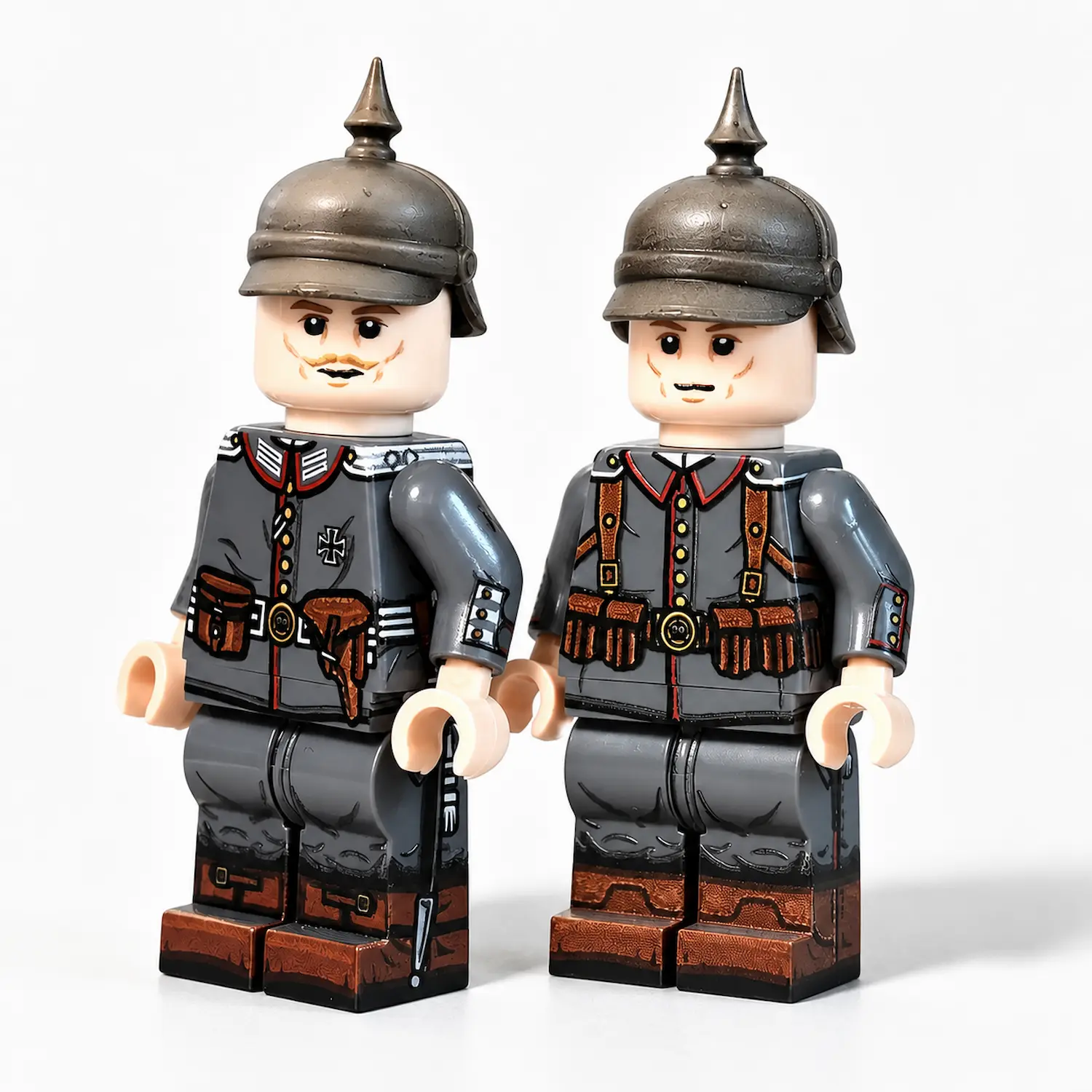
this showcases two highly detailed custom building block figures standing side-by-side.
Together, they represent the distinct hierarchy of the Imperial German Army (Deutsches Heer) during the opening campaigns of World War I in 1914, contrasting the aristocratic officer class with the standard frontline conscript.
Here is the detailed English description, specific character identification, and historical background for both figures, introduced one by one from left to right.
1. Left Figure: The Elite Junior Officer
-
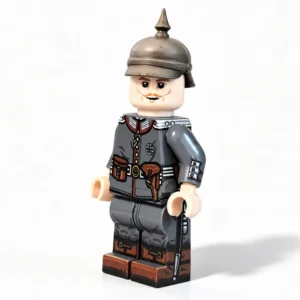
Specific Name: WWI Imperial German Guards Lieutenant (1914) / Garde-Leutnant
-
Role: A commissioned junior officer tasked with leading a platoon or company of elite Prussian Guards infantry into combat.
Detailed Visual Breakdown:
-
Headgear & Face: He wears the iconic Spiked Helmet (Pickelhaube). It is colored in a muted grey, representing the canvas field cover (Überzug) used to hide the shiny brass from enemy snipers. He features a confident expression with a prominent, well-groomed light-brown mustache.
-
Uniform (The Guards Tunic): He is dressed in the Field Grey (Feldgrau) officer’s tunic. Crucially, the collar and cuffs feature double silver braids (Doppellitzen), which historically marked the wearer as a member of an elite Guards Regiment (Garde-Regiment).
-
Rank & Medals: He wears silver officer shoulder boards. Printed proudly on his left breast is the Iron Cross 1st Class (Eisernes Kreuz 1. Klasse), indicating notable battlefield bravery.
-
Tactical Gear: Unlike the enlisted man, he wears a printed black-and-silver striped officer’s waist belt. He carries a brown leather pistol holster and a small utility pouch. A long officer’s sword scabbard is printed hanging down his left leg. He wears polished brown officer’s riding boots.
2. Right Figure: The Frontline Infantryman
-
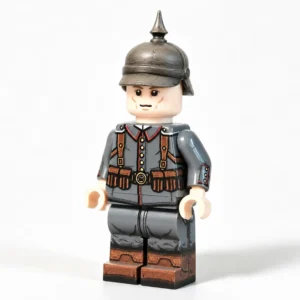
Specific Name: WWI Imperial German Infantryman (1914) / Infanterist
-
Role: A standard enlisted rifleman, the backbone of the German military machine during the initial 1914 invasion offensives.
Detailed Visual Breakdown:
-
Headgear & Face: He wears the same field-covered grey Pickelhaube. His face is distinctly different from the officer’s: he has a thinner mustache and printed dirt/scuff marks, reflecting the exhaustion of forced marches and trench combat.
-
Uniform (The Enlisted Tunic): He wears the standard enlisted Field Grey (Feldgrau) tunic. Instead of the officer’s silver braids, his tunic features standard red infantry piping down the center closure, around the collar, and on the cuffs.
-
Tactical Gear (The Webbing): His gear is built for carrying heavy ammunition. Over his tunic, he wears brown leather Y-straps connecting to a standard leather waist belt with a brass Imperial buckle. Attached to the belt are large, heavily detailed Model 1909 ammunition pouches, designed to hold 5-round stripper clips for his Gewehr 98 rifle. He wears tall brown marching boots (Marschstiefel), often called Jackboots.
Historical Background: The Look of 1914
These two figures perfectly capture the aesthetic of the Imperial German Army before the grueling stalemate of trench warfare forced them to adapt.
-
The Feldgrau Innovation: Prior to this era, European armies wore bright colors. The German military transitioned to Field Grey (Feldgrau) to provide camouflage against modern smokeless-powder rifles. It was an early and highly effective military innovation.
-
The Obsolete Helmet: The Pickelhaube was a symbol of 19th-century Prussian martial pride. However, made mostly of boiled leather, it offered absolutely no ballistic protection against the defining weapon of WWI: artillery shrapnel. The grey coloring on these toys accurately reflects the cloth covers issued to hide the spikes, but by 1916, the leather helmets were entirely replaced by the iconic steel Stahlhelm.
-
Officers vs. Enlisted: The stark contrast between these figures is historically accurate for 1914. Officers (left) retained traditional symbols of authority like striped belts and swords, and were expected to lead charges from the front. This made them prime targets for French and British marksmen, leading to devastatingly high officer casualty rates early in the war. Later in the war, surviving officers would dress identically to the enlisted men (right) to avoid sniper fire.
Reviews
There are no reviews yet