

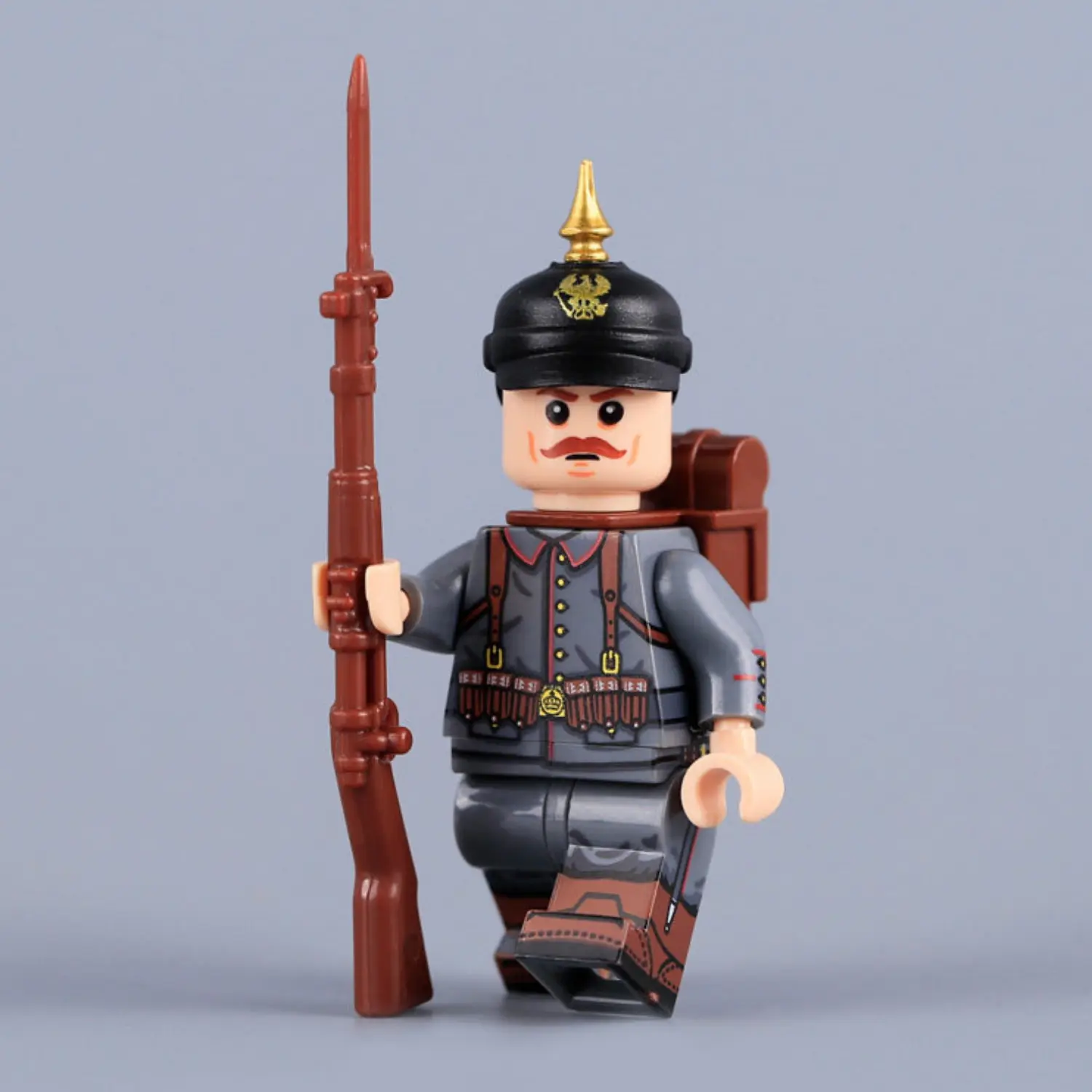
this showcases a single, highly detailed custom building block figure representing a standard infantryman from the early stages of the First World War.
Here is the detailed English description, specific character identification, and historical background for this military figure.
Character Identification: The 1914 Frontline Rifleman
-
Specific Name: WWI Imperial German (Prussian) Infantry Soldier / Rifleman
-
Role: An enlisted frontline infantryman (Schütze or Musketier) of the Imperial German Army (Deutsches Heer), specifically representing the Prussian contingent during the outbreak and early stages of World War I (circa 1914–1915).
Detailed Visual Breakdown
-
Headgear (The Pickelhaube): The figure wears the iconic black leather Spiked Helmet (Pickelhaube). It features a prominent gold spike and the golden Prussian Eagle emblem (Wappen) printed on the front front, identifying his specific state allegiance within the German Empire.
-
Facial Features: He sports a serious, disciplined expression complete with a prominent reddish-brown mustache, accurately reflecting the popular grooming standards for European soldiers during the early 20th century.
-
Upper Body Uniform (The Feldgrau Tunic):
-
He is dressed in the standard Field Grey (Feldgrau) enlisted man’s tunic.
-
Insignia & Details: The tunic features historically inspired red piping down the front closure, around the collar, and on the cuffs, which was standard for infantry regiments.
-
-
Tactical Gear (The Webbing):
-
Front: Over his tunic, he wears printed brown leather Y-straps connected to a brown leather waist belt with an Imperial belt buckle. Attached to the belt are highly detailed printed Model 1909 ammunition pouches, designed to hold 5-round stripper clips for his rifle.
-
Back (The Assault Pack): The “Behind” view reveals printed details of a brown canvas assault pack (Tornister) with a vibrant green rolled shelter-half/blanket strapped to it. A separate 3D molded brown backpack accessory is also worn over the printing to give the figure depth.
-
Side: Visible in the “Side – Left” view, a highly detailed printed bayonet scabbard hangs from his left hip.
-
-
Lower Body: He wears matching field grey trousers with red piping running down the outer seams, tucked securely into tall brown leather marching boots (often called Jackboots or Marschstiefel).
-
Weapon Accessory (The Rifle & Bayonet): The figure is armed with a long brown plastic weapon accessory representing the standard-issue Gewehr 98 bolt-action rifle. Crucially, it features a long, fixed bayonet (Seitengewehr) attached to the muzzle, preparing him for close-quarters melee combat.
Historical Background: The March to War
This figure perfectly encapsulates the classic appearance of the German army as it marched to war in August 1914, before the realities of the trenches forced them to adapt.
-
The Feldgrau Innovation: Before 1907, Prussian soldiers wore bright blue uniforms. Realizing that modern smokeless powder and long-range rifles made brightly colored troops easy targets, the German military transitioned to the muted Field Grey (Feldgrau) uniform depicted here. It was one of the first modern attempts at military camouflage.
-
The Vulnerable Helmet: The spiked Pickelhaube was a symbol of 19th-century Prussian martial pride, but it was disastrously obsolete for modern warfare. Made of boiled leather, it offered absolutely no ballistic protection against the relentless artillery shrapnel of WWI. Furthermore, the shiny brass spike made soldiers visible over the trench parapets, attracting enemy snipers. By 1916, it was entirely replaced by the iconic steel Stahlhelm.
-
The Gewehr 98 & Bayonet: The primary weapon of this soldier was the Mauser Gewehr 98. It was a highly accurate, reliable, and powerful rifle. When fitted with its unusually long sword-bayonet (as seen on this figure), it acted like a spear, giving the soldier excellent reach to defend against cavalry charges or to fight hand-to-hand in the early, mobile battles of the war.
Reviews
There are no reviews yet