

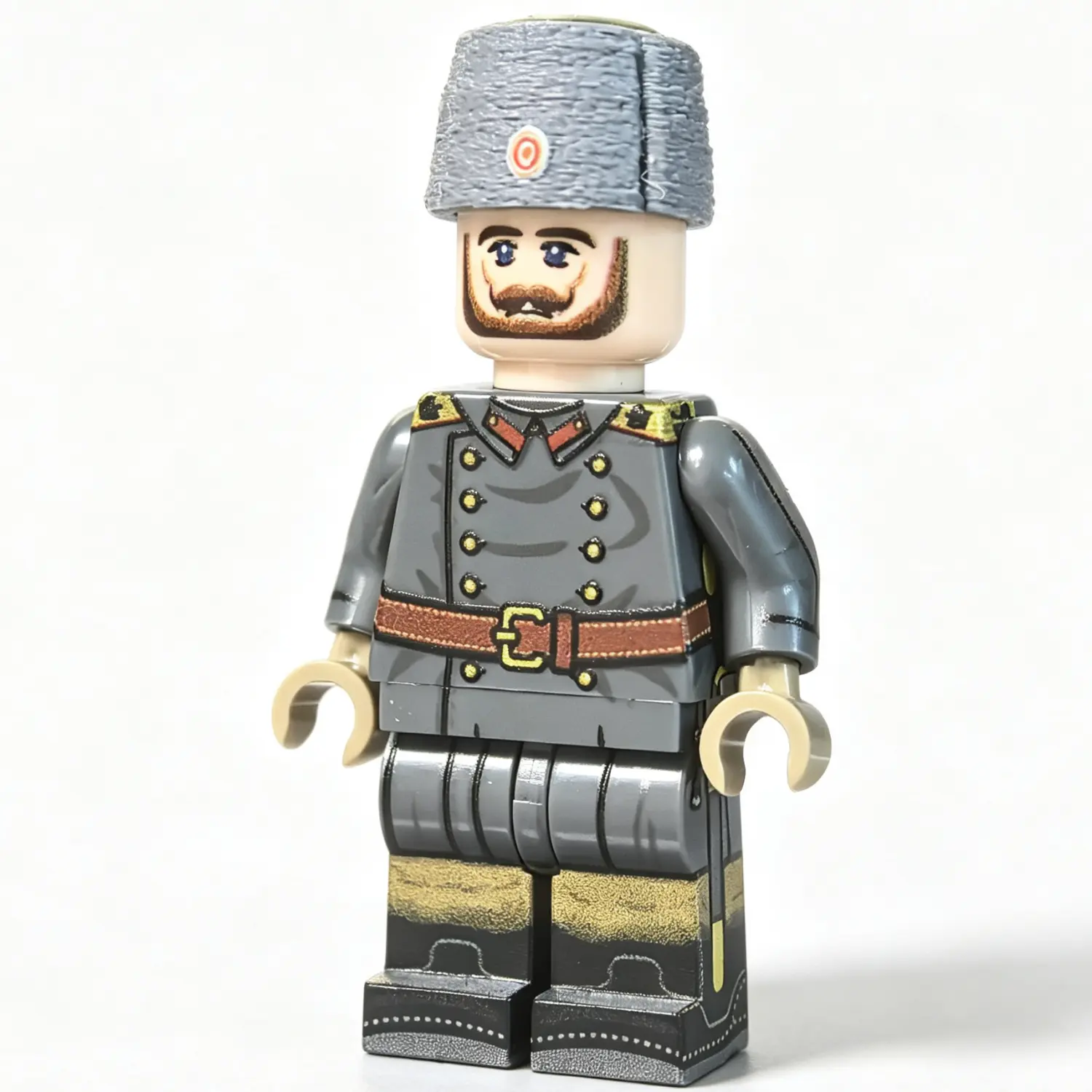
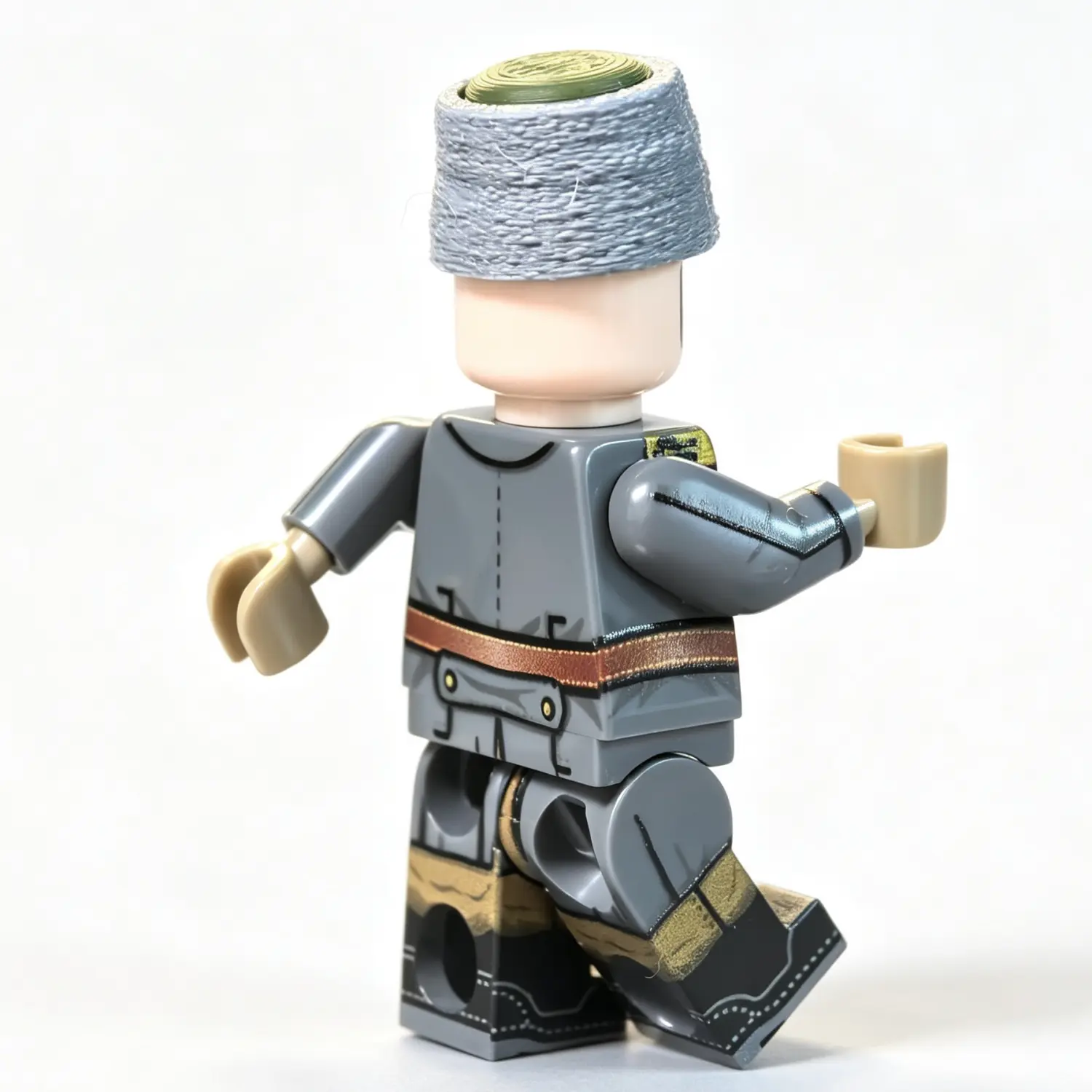
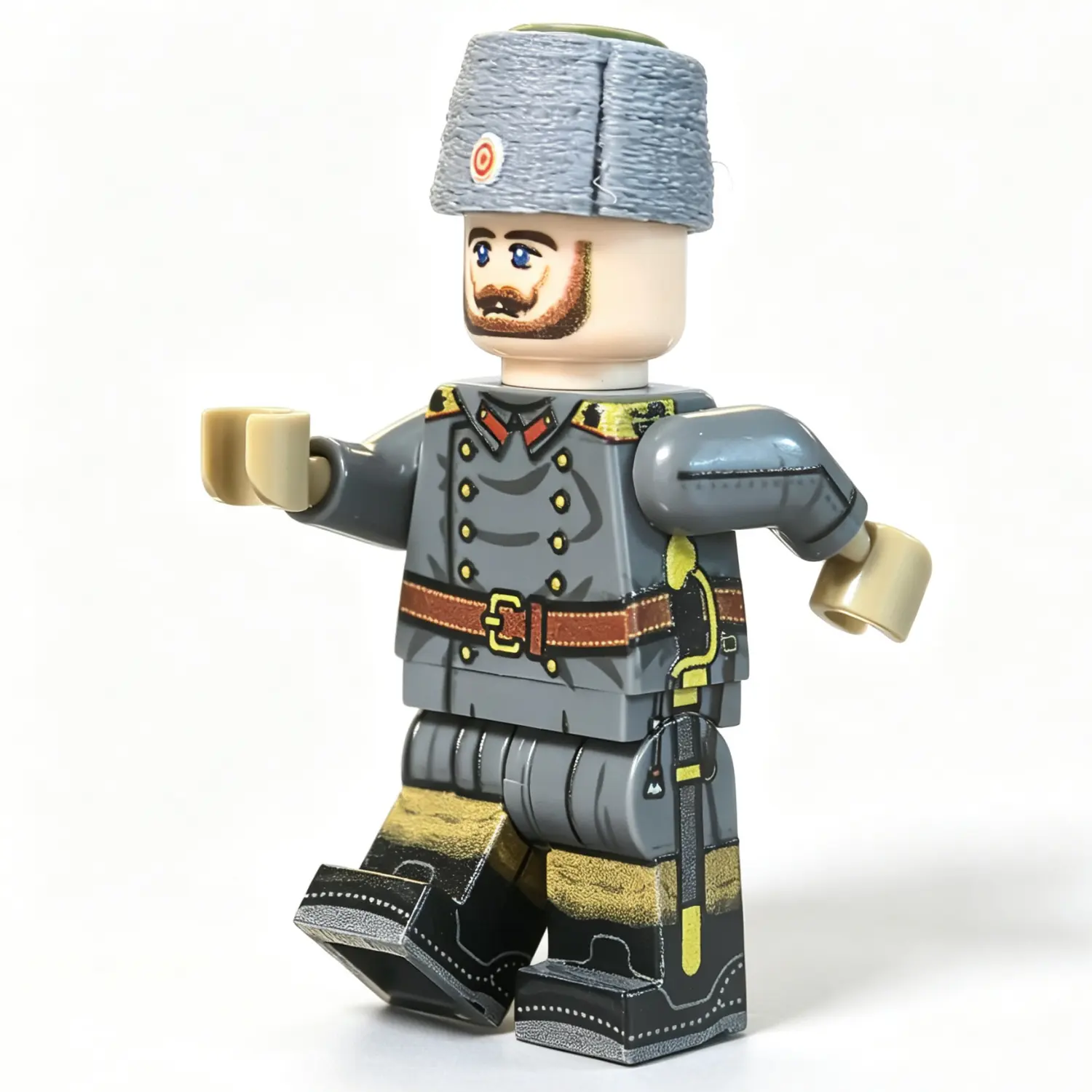
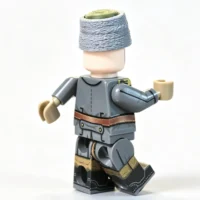
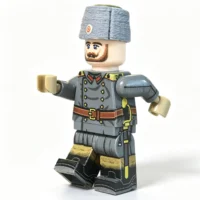
these images display a single, highly detailed custom figure from different perspectives.
Here is the detailed English description, specific character identification, and historical background for this royal World War I figure.
Character Identification: The Last Tsar of Russia
This Custom Printed Brick Block Figure represents the Supreme Commander of the Imperial Russian Army during World War I. Specifically, the facial hair and uniform details identify him as Tsar Nicholas II (Nikolai II), the last Emperor of the Romanov dynasty, outfitted in his frontline winter command uniform.
Detailed Visual Breakdown
-
Specific Name: Imperial Russian Supreme Commander / Tsar Nicholas II (WWI Winter Campaign)
-
Headgear (The Papakha): Like his men, he wears the traditional grey fur Papakha winter hat. Pinned to the front is the Imperial Romanov cockade, the official insignia of the Russian Empire.
-
Facial Features: The figure features a calm, regal expression with bright blue eyes, a neatly groomed brown mustache, and a full beard. This is a highly accurate recreation of Nicholas II’s historical likeness.
-
Upper Body Uniform (Officer’s Shinel):
-
Unlike the enlisted men’s simple coats, the Tsar is dressed in a premium, tailored officer’s Shinel (greatcoat). It is double-breasted, featuring two distinct rows of bright gold buttons and elegant red piping on the collar lapels.
-
Royal Insignia: His shoulders are adorned with bright gold shoulder boards (Pogony), which designate his supreme royal and military authority.
-
-
Tactical Gear & Accessories: * Front Loadout: As a commander, he carries no heavy ammunition pouches or survival backpacks. He wears a simple, sleek brown leather officer’s belt with a brass buckle.
-
The Shashka (Sidearm): Visible on his left hip (in image
详情-04.webp) is a highly detailed printed scabbard and golden hilt of a Shashka—the traditional, guardless saber used by Russian cavalry and officers.
-
-
Lower Body & Weathering: He wears grey officer’s breeches tucked into black leather boots. His boots feature a dusting of frost and yellowish mud weathering. Notably, it is lighter than the thick, caked snow seen on enlisted figures, reflecting a commander who visits the trenches but does not sleep in them.
Historical Background: The Tsar at the Front
This figure captures a pivotal and ultimately fatal chapter in Russian history.
-
Taking Command (1915): Following a series of catastrophic defeats at the hands of the German and Austro-Hungarian armies in the first year of WWI, Tsar Nicholas II made a fateful decision. Against the advice of his ministers, he dismissed his experienced generals, traveled to the Stavka (military headquarters), and took direct, personal command of the Imperial Russian Army.
-
The Frontline Wardrobe: Nicholas II often wore standard military uniforms, like the Shinel and Papakha depicted here, rather than elaborate royal dress. He did this to project an image of solidarity with his freezing, suffering troops at the front.
-
The Fall of the Romanovs: While his presence at the front was meant to boost morale, it had the opposite effect. By taking personal command, every subsequent military failure, supply shortage, and massive casualty list was blamed directly on him. With the Tsar away at the front, political instability boiled over in Petrograd (St. Petersburg), culminating in the 1917 February Revolution, forcing him to abdicate his throne and ending over 300 years of Romanov rule.
Reviews
There are no reviews yet