

Variations
-
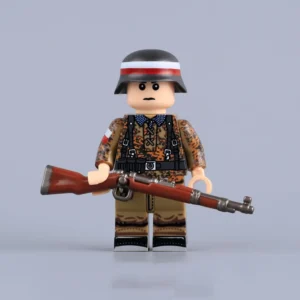
Polish Home Army Soldier (Captured Oak Leaf Autumn Smock) WWII – Custom Printed Brick Block Figure
$14.99 -
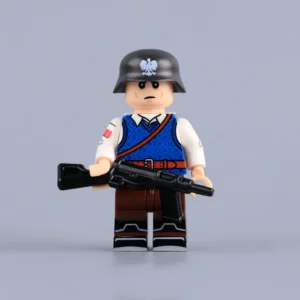
Polish Home Army Courier (Warsaw Uprising) WWII – Custom Printed Brick Block Figure
$14.99 -
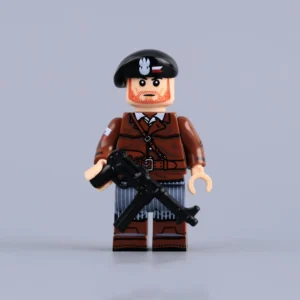
Polish Home Army Commander (Warsaw Uprising) WWII – Custom Printed Brick Block Figure
$14.99 -
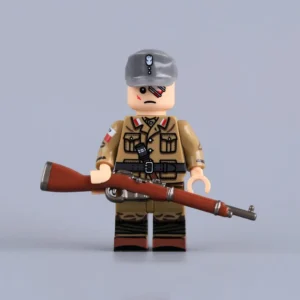
Battle-Wounded Polish Infantry (Warsaw Uprising) WWII – Custom Printed Brick Block Figure
$14.99
Introduction
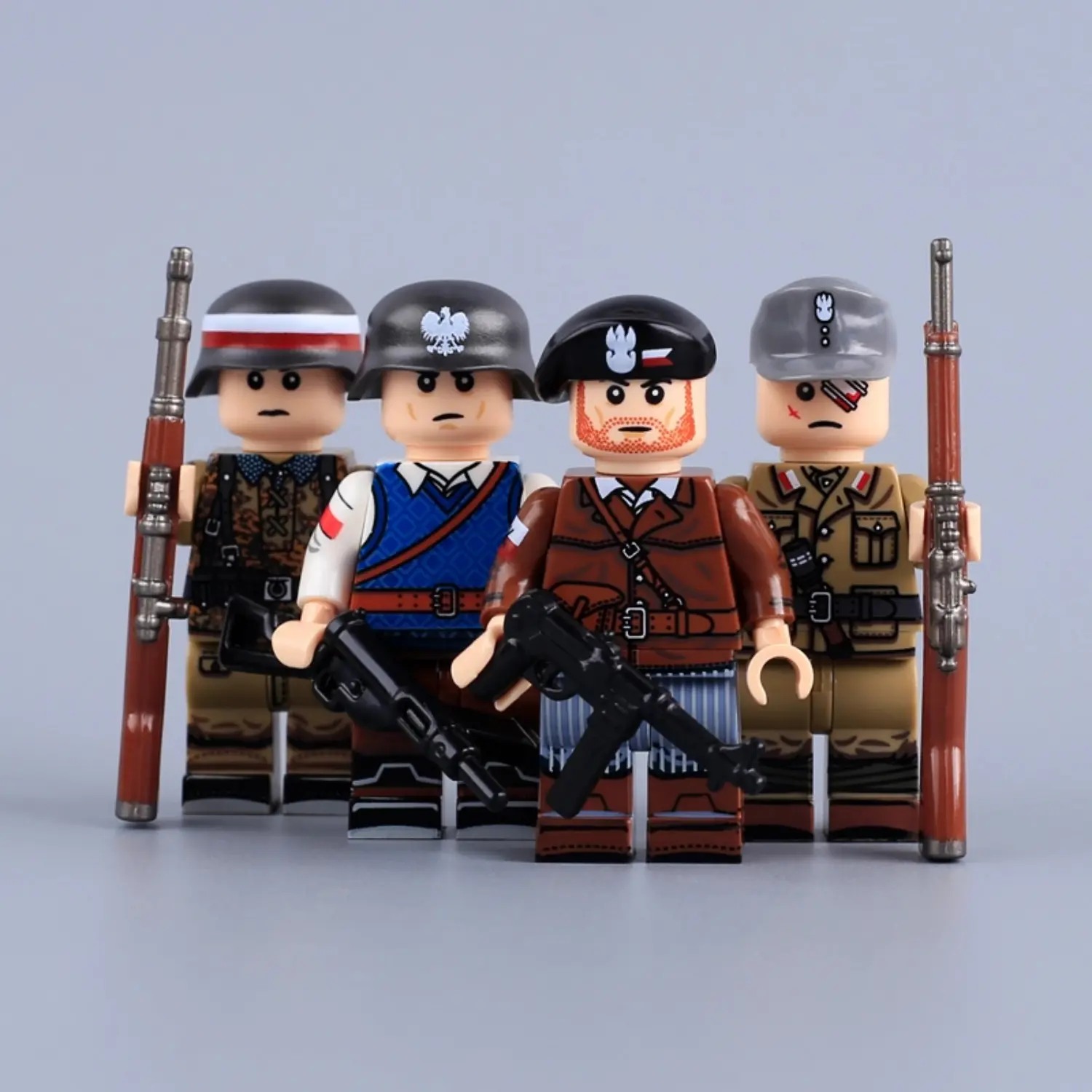
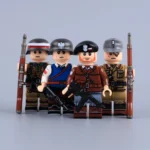
this is a four-piece collection of custom building block figures representing a squad of resistance fighters from the Polish Home Army (Armia Krajowa, or AK) during the historic Warsaw Uprising of 1944.
Here is the detailed character identification, visual description, and historical background for each figure in the squad, moving from left to right (based on the unequipped lineup image).
1. Polish Home Army Commander (Far Left)
-
Specific Identification: A commanding officer or unit leader of the underground resistance.
-
Detailed Visuals: This building block figure features a striking mix of civilian and military attire. He wears a black military beret stamped with the Polish White Eagle (Orzeł Biały) and a small national flag stripe. He has a distinct printed orange beard. His torso features a civilian brown leather jacket with a cross-body strap. His lower half features blue and white pinstriped trousers (typical of 1940s civilian suits) tucked into combat boots. Most importantly, his right arm bears a red and white armband printed with “AK”, explicitly identifying his allegiance.
-
Historical Background: Because the Polish resistance was a secret underground army, they lacked standardized uniforms. Commanders often wore durable civilian clothing like leather jackets. The red and white armband was the universal identifier for Polish fighters, and the “AK” designated them as the official Home Army, loyal to the Polish government-in-exile in London.
2. Camouflage Infantry Soldier (Center Left)
-
Specific Identification: A frontline resistance fighter utilizing captured enemy equipment.
-
Detailed Visuals: This figure wears a captured dark grey Stahlhelm (steel helmet). To mark it as friendly, a thick white and red Polish flag stripe is painted around the bowl. He wears a highly detailed camouflage smock over a civilian blue-and-white polka-dot neckerchief. He is equipped with standard combat suspenders and a plain red and white armband on his left arm.
-
Historical Background: To arm and clothe themselves during the 63-day uprising, Polish fighters heavily relied on capturing German supply depots (such as the famous capture of the Stawki depot). It was incredibly common for AK soldiers to wear captured German camouflage. To avoid deadly friendly fire while wearing enemy gear, they prominently painted their national colors on their helmets and wore armbands.
3. Resistance Courier / Messenger (Center Right)
-
Specific Identification: A liaison or courier (通讯员) tasked with delivering vital communications.
-
Detailed Visuals: This building block character embraces a heavy civilian aesthetic, wearing a bright blue diamond-knit sweater vest over a crisp white shirt. He wears a captured helmet prominently stamped with the Polish White Eagle. As seen in the back-view image, he carries a small brown leather messenger pouch strapped across his back. He also wears the standard red and white national armband.
-
Historical Background: During the Warsaw Uprising, the city was reduced to rubble, and telephone lines were severed. The Home Army relied entirely on human couriers—often young men, women, and scouts—to navigate the dangerous, sniper-filled streets and sewer systems to deliver orders, intelligence, and mail between isolated pockets of resistance.
4. Battle-Wounded Veteran Infantry (Far Right)
-
Specific Identification: A battle-hardened veteran wearing a pre-war Polish military uniform.
-
Detailed Visuals: This figure wears a grey field cap (resembling the Polish rogatywka) with the White Eagle. His face shows the grim reality of urban warfare, featuring a prominent bloody eye bandage and facial scratches. Unlike the others, he wears a khaki pre-war Polish Army tunic with red and white pennant collar tabs and a tactical flashlight strapped to his chest. His right arm features a specialized armband printed with “WP” and the “Kotwica” (Anchor) symbol.
-
Historical Background: While many fought in civilian clothes, some fighters managed to retrieve hidden caches of pre-war Polish Army (Wojsko Polskie) uniforms. Wearing these was a massive point of national pride. The “WP” on his armband stands for Wojsko Polskie, declaring him a legitimate soldier. The Kotwica (an anchor combining the letters P and W for Polska Walcząca – “Fighting Poland”) was the ultimate symbol of Polish defiance and the Secret State.
Reviews
There are no reviews yet