

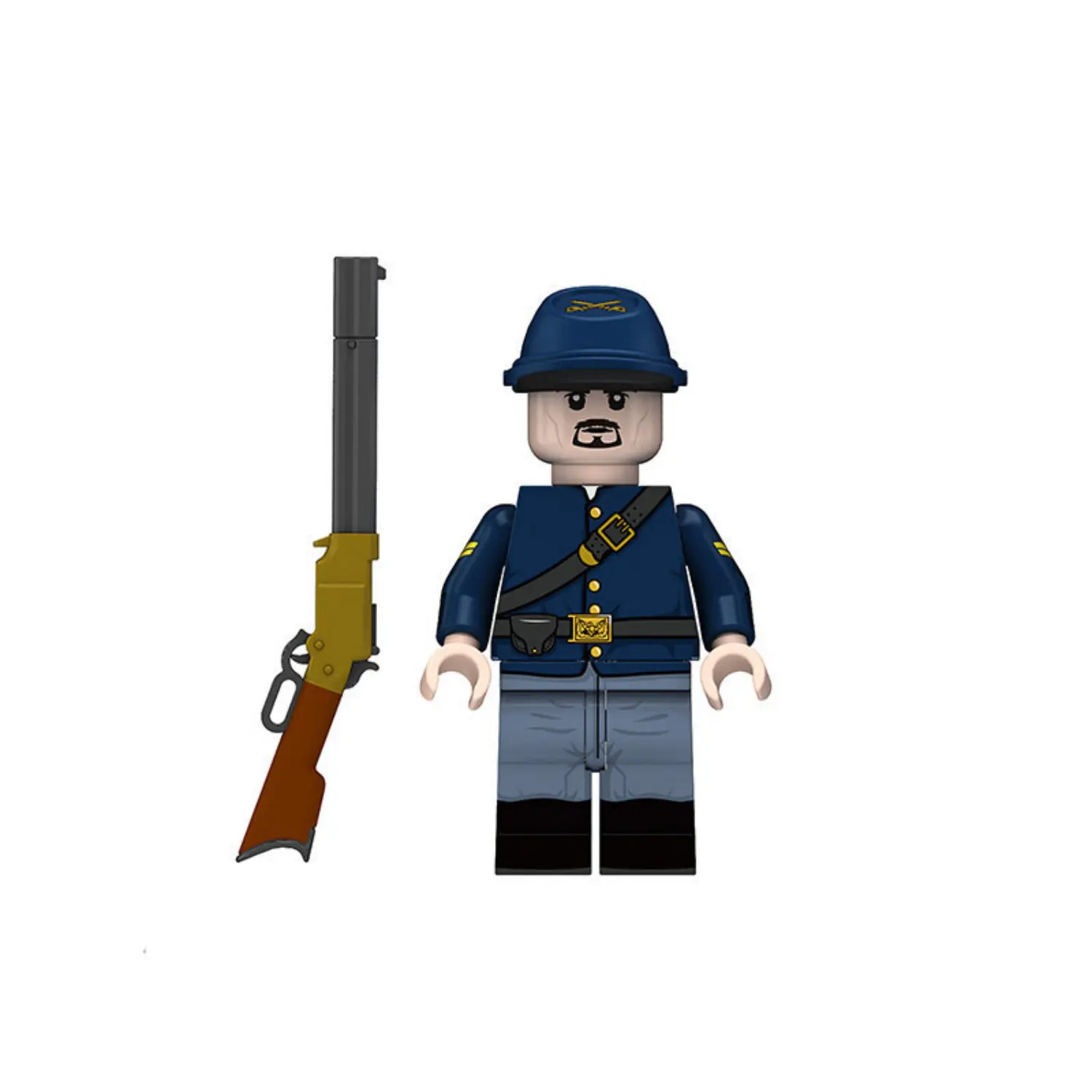
Character Identification: Union Army Cavalry Corporal
This image displays a 2D design render for a Custom Printed Brick Block Figure representing a junior non-commissioned officer (NCO) in the Union Army’s Cavalry branch during the American Civil War (1861–1865).
Specific Name and Visual Details
-
Specific Name: Union Army Cavalry Corporal (Cpl. Cav.)
-
Headgear (The Kepi): He wears a standard federal blue forage cap (kepi). The front of the cap features a detailed, yellow/gold crossed sabers insignia, which was the official and universal military symbol designating the Cavalry branch.
-
Facial Features: He features a stylized goatee and mustache, a very common grooming style for soldiers of the 1860s.
-
Upper Body and Branch Colors:
-
He is dressed in a standard-issue dark blue (federal blue) cavalry “shell jacket” (a short waist-length tunic).
-
The Yellow Trim: The collar, front button flap, and sleeve cuffs are detailed with yellow piping/trim. In US military regulations of the era, yellow was the official branch color for the Cavalry.
-
-
Rank Insignia: On his sleeves are two yellow chevrons. In the military ranking system, two chevrons designate the rank of Corporal (下士), making him a junior enlisted leader responsible for a small squad of troopers.
-
Belt and Accoutrements: * He wears a black leather waist belt with a rectangular brass US buckle.
-
Crucially, he wears a black leather cross-belt (carbine sling) diagonally across his chest, which mounted cavalrymen used to secure their short rifles while riding. A small black cap box rests on his waist belt.
-
-
Lower Body: He wears standard Union-issue sky blue trousers paired with high black riding boots, essential for mounted troops.
-
Weapon Accessory: He is armed with an advanced repeating rifle (recognizable by the brass receiver and lever-action, heavily resembling the famous Henry Repeating Rifle). This signifies the massive technological and industrial advantage the Union possessed later in the war.
Historical Background
The cavalry played an incredibly dynamic role in the American Civil War, acting as the “eyes and ears” of the commanding generals.
-
The Union Cavalry: While initially outmatched by their Southern counterparts at the beginning of the war, the Federal Cavalry was gradually reorganized, better trained, and heavily equipped. By 1863 (around the Battle of Gettysburg), the Union Cavalry had become a formidable, highly effective fighting force capable of screening army movements, conducting massive raids, and fighting effectively both on horseback and dismounted.
-
The Yellow “Waffenfarbe”: The US Army used a strict color-coding system to identify troop types. Yellow represented the swift, mobile cavalry. (Infantry wore light blue, and artillery wore red).
-
The Firepower Advantage: The inclusion of a repeating rifle (like the Henry or Spencer) on this figure is historically vital. While standard infantrymen used single-shot muzzle-loading muskets, the Union government equipped many of its cavalry regiments with lever-action repeaters. Confederates famously described the Henry rifle as “that damn Yankee rifle that they load on Sunday and shoot all week.” This gave a small squad commanded by a Corporal immense, devastating firepower during skirmishes.
Reviews
There are no reviews yet