

Variations
-
US 101st Airborne Radio Operator (Camouflage Face Paint) WWII – Custom Printed Brick Block Figure
$19.99 -
US 101st Airborne Paratrooper (Parachute Harness) WWII – Custom Printed Brick Block Figure
$19.99 -
US 101st Airborne Medic (Red Cross Armband) WWII – Custom Printed Brick Block Figure
$19.99 -
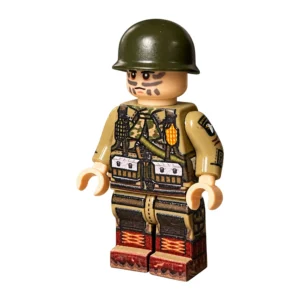
US 101st Airborne Garand Anti-Tank Rifleman (Khaki Uniform) WWII – Custom Printed Brick Block Figure
$19.99
Introduction
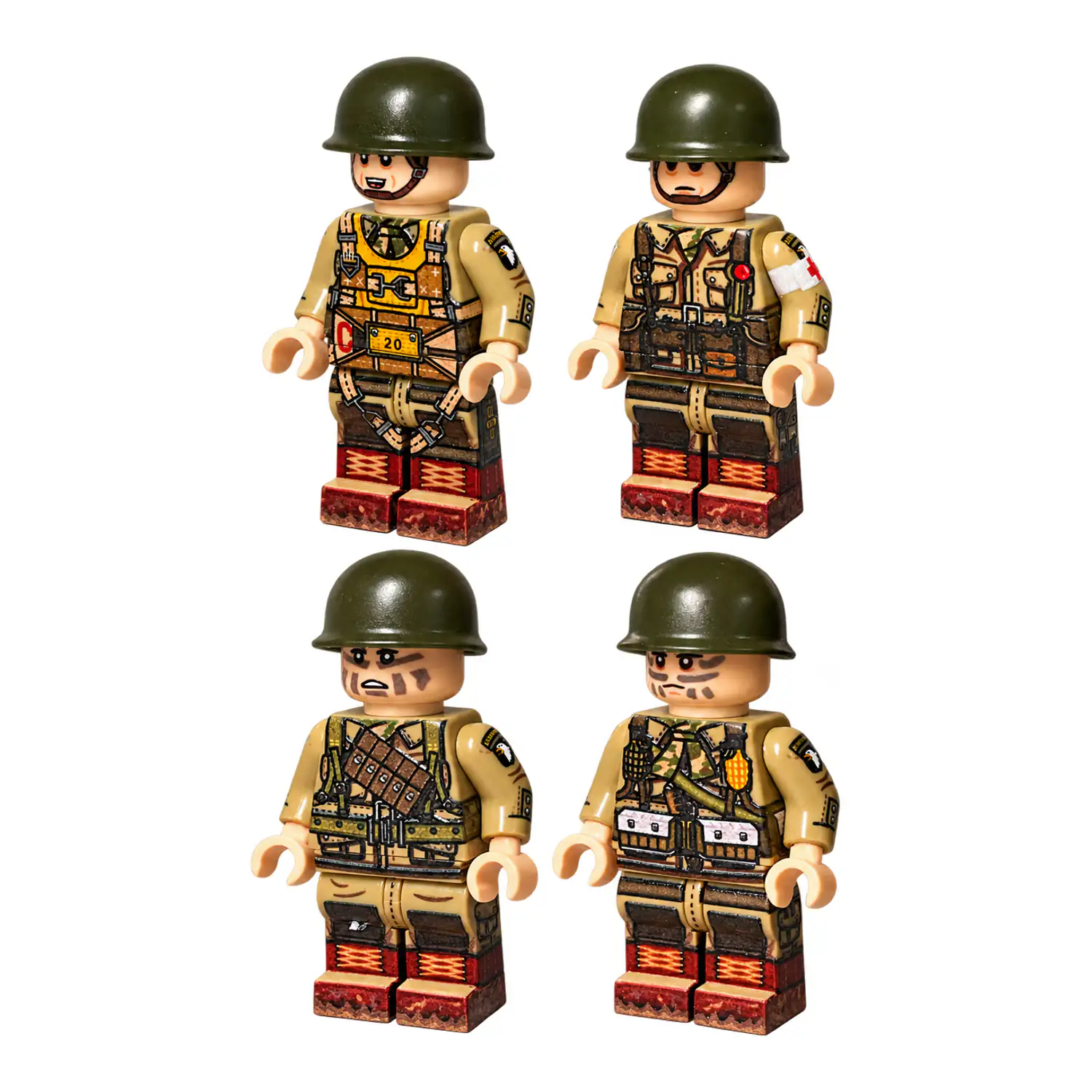
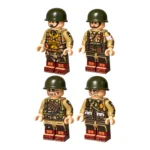
This custom building block set features a highly detailed, historically accurate four-man support squad of the US 101st Airborne Division (“Screaming Eagles”) deployed during the World War II airborne landings. Each figure is uniquely customized to represent a vital, specialized role within an airborne platoon, complete with their iconic M1942 paratrooper uniforms and intricate, role-specific web gear.
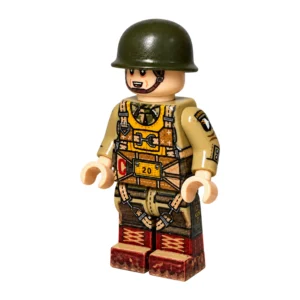
1. US 101st Airborne Paratrooper (Parachute Harness) (Top Left)
Character Identification
This custom figure represents a fully equipped Combat Paratrooper rigged for a combat jump, identifiable by his complex T-5 parachute harness, yellow “Mae West” life preserver, and chest-mounted reserve chute.
Detailed Character Description
(Utilizing precision 360-degree UV printing, this figure captures the incredibly dense, heavy equipment loadout of an American paratrooper moments before exiting the aircraft.) The figure wears an olive-drab M1 steel helmet secured to his head with a printed leather chin cup strap, preventing it from flying off during the parachute’s opening shock. His face shows a determined, shouting expression. Over his tan M1942 Paratrooper Jump Jacket (which features a printed camouflage silk scarf and the 101st Airborne patch), he wears a massively complex T-5 parachute harness. The printing intricately details the heavy canvas webbing, metallic quick-release hardware, and the bright yellow B-4 “Mae West” inflatable life preserver strapped to his upper chest. His lower torso bears the bulky reserve parachute pack, marked with a prominent red “C” and a yellow inspection tag reading “20”. The harness straps loop heavily around his upper thighs over his M1942 trousers, which feature dark canvas knee reinforcements and end in brown leather Corcoran jump boots heavily caked in mud.
Historical Background
During the D-Day invasion on June 6, 1944, paratroopers jumped into the dark skies over Normandy encumbered by over 100 pounds of gear. The T-5 static-line parachute assembly was standard issue, consisting of a main back chute and a chest-mounted reserve. The “Mae West” life preservers were mandatory for this operation because flight paths crossed the English Channel and the drop zones were adjacent to deliberately flooded fields where heavily weighed-down paratroopers risked drowning.
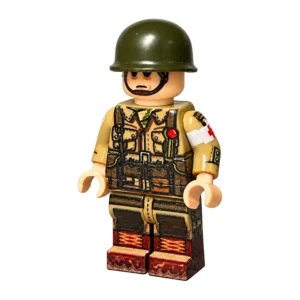
2. US 101st Airborne Medic (Top Right)
Character Identification
This figure represents a dedicated Combat Medic of the 101st Airborne Division, distinguishable as a non-combatant by his white Red Cross armband, specialized medical pouches, and lack of ammunition bandoliers.
Detailed Character Description
(This figure meticulously depicts the specialized, life-saving loadout of an airborne medic operating in the brutal European theater.) Crowned with the standard olive-drab M1 steel helmet, the printed leather chin cup strap is visibly fastened around his chin. His face print conveys a somber, exhausted expression with dark circles and subtle dirt smudges, illustrating the grueling nature of his duty. He wears the classic tan M1942 Paratrooper Jump Jacket with a camouflage scarf tucked inside. On his left shoulder, directly below the 101st Airborne patch, is a large, highly visible white brassard featuring a bold Red Cross. A smaller red circular emblem is printed on his left breast pocket. Unlike the infantrymen, his chest and waist webbing feature no ammo pouches; instead, he wears specialized medic suspenders and cantle ring pouches specifically designed to hold bandages, morphine, and tourniquets. His M1942 trousers feature dark canvas knee reinforcements for kneeling in rubble, finishing with heavily muddied brown leather Corcoran jump boots.
Historical Background
Airborne Combat Medics jumped into the same hostile drop zones as the infantry. Often unarmed, they relied on their Red Cross markings for protection under the Geneva Conventions, though this offered little safety against artillery or nighttime crossfire. Medics had to carry all their plasma, sulfa powder, and field dressings on their person during the jump, utilizing their oversized M1942 cargo pockets and specialized webbing to establish makeshift aid stations behind enemy lines.
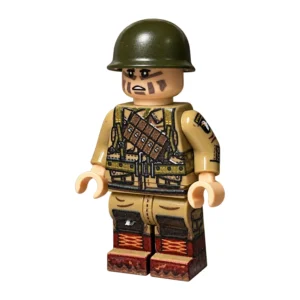
3. US 101st Airborne Radio Operator (Bottom Left)
Character Identification
This figure represents an airborne Radio Operator, easily recognized by his heavy dark tactical facial camouflage and the diagonally slung six-pocket cotton ammunition bandolier across his chest.
Detailed Character Description
(Showcasing highly detailed UV printing, this figure highlights the heavily armed, stealth-oriented look of a paratrooper tasked with defending vital communication lines.) The figure wears an olive-drab M1 steel helmet. His face is heavily printed with thick, aggressive stripes of dark black tactical camouflage, and his expression is open-mouthed, as if yelling coordinates over the radio. He is dressed in the M1942 Paratrooper Jump Jacket with the 101st Airborne patch and a camouflage neck scarf. Because he carries a heavy backpack radio (implied by his heavy suspender harness), his front webbing is geared entirely for self-defense and rapid reloading. He wears an M1923 cartridge belt loaded with ammunition around his waist, overlaid with a prominent cotton bandolier slung diagonally across his chest. His matching M1942 trousers include large cargo pockets and dark canvas knee reinforcements, terminating in intricate, mud-splattered Corcoran jump boots.
Historical Background
During night drops, paratroopers frequently applied burnt cork, soot, or grease to their faces to eliminate skin glare in the moonlight. The Radio Operator was one of the most critical and highly targeted men in the platoon, carrying the heavy SCR-300 backpack radio (the “walkie-talkie”) to coordinate scattered troops and call in naval artillery. Because their large antennas drew heavy enemy sniper fire, operators armed themselves heavily with extra bandoliers to ensure they could survive isolated firefights.
4. US 101st Airborne Anti-Tank Rifleman (Bottom Right)
Character Identification
This figure represents a specialized Anti-Tank Rifleman, distinguished by his dark tactical facial camouflage, specialized white-flapped ordnance pouches, and a chest rig loaded with fragmentation and smoke grenades.
Detailed Character Description
(This figure captures the incredibly dense, heavy ordnance loadout required to take on enemy armor without traditional mechanized support.) He wears a standard olive-drab M1 steel helmet. His face features intense horizontal stripes of dark black tactical camouflage over a stern, highly focused expression. Over his tan M1942 Paratrooper Jump Jacket (featuring the 101st Airborne patch and camo scarf), he wears a highly specialized ordnance rig. Over top of his standard M1923 cartridge belt, he wears unique white-flapped specialized pouches, likely carrying rifle grenades or blank propelling cartridges. His suspenders are heavily laden with quick-access explosives: a green Mk 2 “Pineapple” fragmentation grenade is printed on his right shoulder, while a yellow M18 smoke grenade is secured on his left. His lower half consists of M1942 trousers with oversized cargo pockets, dark canvas knee reinforcements, and highly detailed, mud-soaked Corcoran jump boots.
Historical Background
Paratroopers dropping into Normandy lacked heavy artillery or armored tank support during the initial hours of the invasion. To defend against German mechanized units and Panzer divisions, platoons relied on Anti-Tank Riflemen equipped with M1 Garand rifles adapted to fire M9A1 high-explosive anti-tank (HEAT) rifle grenades. These specialists were burdened with massive amounts of explosive ordnance, utilizing fragmentation grenades for infantry and brightly colored smoke grenades to signal targets for close air support.
Reviews
There are no reviews yet