

Variations
-
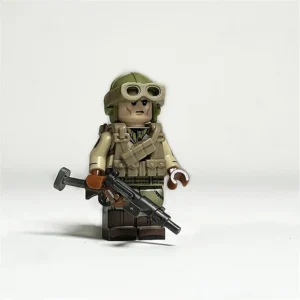
US Army Armored Division Tank Commander – Custom Printed Brick Block Figure
$14.99Rated 1.00 out of 5(1)(1.00)
Introduction
Detailed Character Profiles: Identification, Description, and History
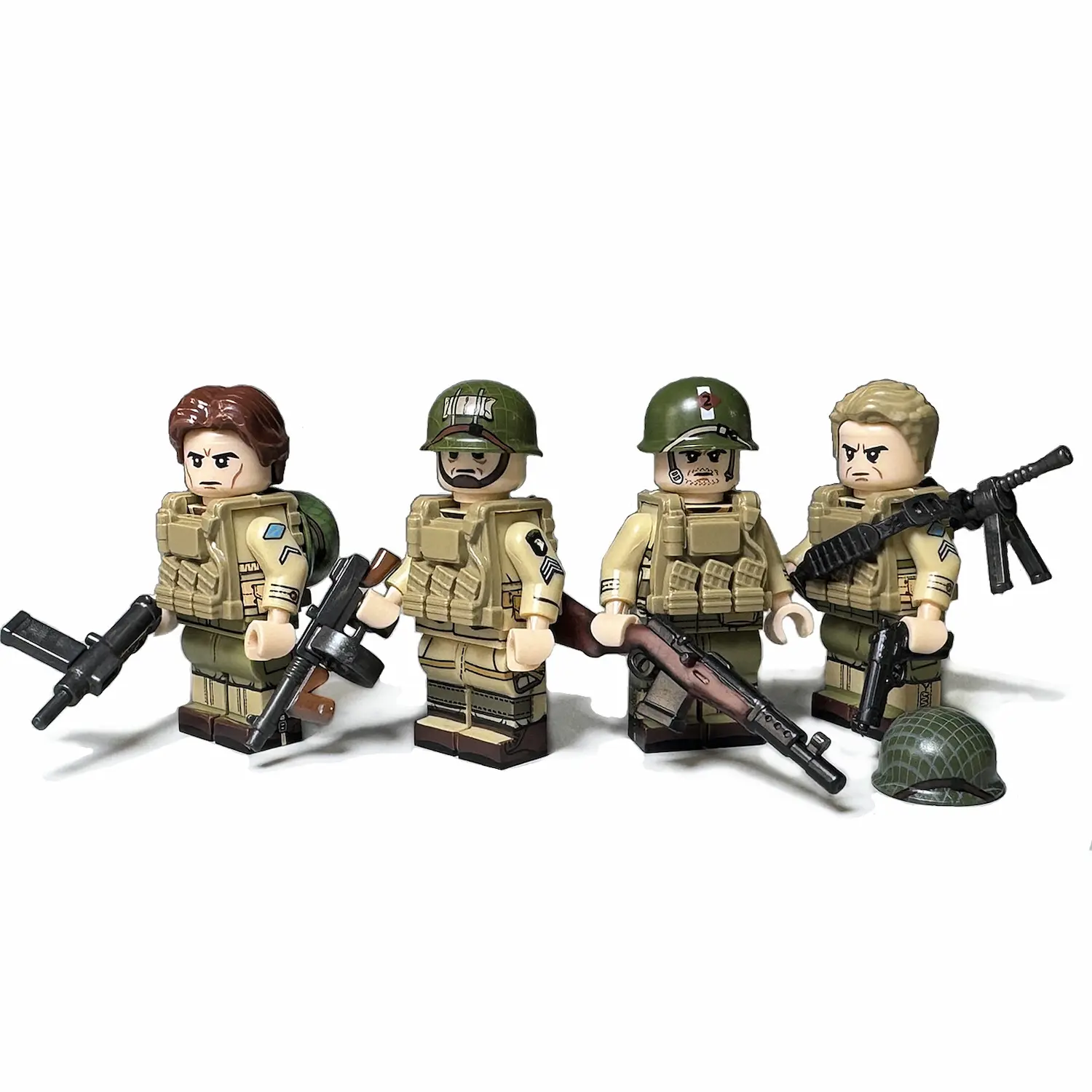
Here is a detailed, one-by-one breakdown of the four figures from left to right.
1. US Army Ranger Captain (Far Left)
Character Identification: WWII US Army Ranger Company Commander (Inspired by Captain John Miller).
Detailed Description: This figure depicts a battle-weary commanding officer. Instead of a helmet, he features a molded brown hairpiece. His torso is outfitted with a tan tactical vest featuring detailed utility pouches, worn over a standard olive-drab infantry uniform. Crucially, his left shoulder displays the blue diamond-shaped patch with a yellow border, identifying him as a US Army Ranger. He is armed with a classic brick-built Thompson submachine gun, and his face print features a resolute, exhausted expression with subtle battle dirt.
Historical Background: US Army Rangers were elite, specially trained light infantry. During the D-Day invasions on June 6, 1944, officers led from the front lines under devastating fire on Omaha Beach. Captains typically carried Thompson submachine guns because their high rate of fire was invaluable for close-quarters trench and bunker clearing operations.
2. 101st Airborne Paratrooper (Center Left)
Character Identification: WWII 101st Airborne Division Paratrooper (Inspired by Private James Ryan).
Detailed Description: This figure represents the airborne infantryman the Rangers are searching for. He wears an olive-drab M1 helmet adorned with a highly distinct white spade symbol, and features a printed chin strap on his face. His left arm bears the famous “Screaming Eagle” patch of the 101st Airborne Division. He wears a specialized tan paratrooper chest rig over his jump uniform and carries a standard submachine gun/carbine.
Historical Background: The 101st Airborne Division was dropped behind enemy lines in Normandy hours before the naval landings. The white spade symbol specifically denoted the 506th Parachute Infantry Regiment (PIR). These symbols were painted on helmets to help scattered paratroopers quickly identify members of their own regiment in the dark and chaotic hours following the combat drops.
3. US Army Ranger Technical Sergeant (Center Right)
Character Identification: WWII 2nd Battalion Ranger NCO (Inspired by Technical Sergeant Mike Horvath).
Detailed Description: This figure portrays a hardened Non-Commissioned Officer (NCO). He wears an M1 helmet featuring a prominent orange diamond with a white “2”, accurately marking him as a member of the 2nd Ranger Battalion. He wears the Ranger diamond patch on his sleeve and is heavily laden with tan ammunition webbing and pouches. He is armed with the iconic M1 Garand rifle, the standard-issue infantry weapon of the US military, and his face print shows a stern, determined combat veteran.
Historical Background: The 2nd Ranger Battalion achieved legendary status on D-Day by scaling the sheer, 100-foot cliffs of Pointe du Hoc under heavy enemy fire to destroy a German artillery battery. NCOs were the absolute backbone of these units, maintaining squad discipline and directing fire during some of the most brutal localized fighting of the war.
4. US Army Ranger Automatic Rifleman (Far Right)
Character Identification: WWII US Army Ranger BAR Gunner (Inspired by Private Richard Reiben).
Detailed Description: This figure represents the squad’s heavy firepower specialist. He is depicted with a blonde hairpiece, with his spare olive-drab M1 helmet resting on the ground next to him. Like the other Rangers, he wears the blue and yellow Ranger patch on his arm and a tan tactical vest. His defining feature is the massive weapon he carries: a Browning Automatic Rifle (BAR) complete with a folding bipod. His face print captures a cynical but focused combat expression.
Historical Background: The BAR gunner was the most critical tactical asset in a US infantry squad. Firing heavy .30 caliber rounds, the BAR provided the mobile base of fire needed to suppress enemy machine-gun nests. Because the weapon and its ammunition were incredibly heavy, BAR gunners had to be exceptionally strong and resilient, often becoming the primary targets for German defenders.
one was a paratrooper. The rest were army rangers.
Hi James, sorry for the inconvience, we modify the product description as you request, thanks for your suggestions!